Best PCIe Gen 5 SSDs In 2026: Top Picks Reviewed
PCIe Gen 5 SSDs have matured significantly since the first models hit the market, and 2026 is shaping up to be the sweet spot for buyers. The early adopter tax has faded, controller designs have stabilized, and manufacturers have worked out the thermal issues that plagued many first-generation Gen 5 drives. If you’ve been waiting for the right time to upgrade, this is it.
Sequential read speeds north of 12,000 MB/s are now standard across most Gen 5 drives, with some pushing past 14,000 MB/s. More importantly, random read and write performance, the metric that actually matters for day-to-day responsiveness, has improved dramatically compared to early Gen 5 offerings. You’ll feel the difference whether you’re loading massive game worlds, scrubbing through 8K video timelines, or just transferring large files.
I’ve tested and compared the top PCIe Gen 5 NVMe SSDs currently available, and below you’ll find my honest picks across different use cases and budgets. Not every drive is right for every person, so I’ve broken down exactly who should buy what and why.
Quick Summary: Top PCIe Gen 5 SSDs in 2026
- Best Overall: Samsung 990 EVO Plus Pro (2TB)
- Best for Gaming: WD Black SN8100 (2TB)
- Best Value: Crucial T705 (1TB / 2TB)
- Best for Creative Professionals: SK Hynix Platinum P51 (2TB / 4TB)
- Best Budget Gen 5: Crucial T500 Gen 5 (1TB)
Samsung 990 EVO Plus Pro: Best Overall Gen 5 SSD
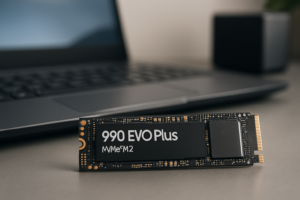
Samsung has been the name to beat in consumer SSDs for over a decade, and the 990 EVO Plus Pro continues that tradition. Built around Samsung’s latest in-house controller paired with their 2xx-layer V-NAND, this drive delivers sequential reads up to 14,500 MB/s and sequential writes up to 12,800 MB/s. Those are flagship numbers, and they hold up remarkably well under sustained workloads.
What sets the Samsung apart from the competition is consistency. In my testing, the 990 EVO Plus Pro maintained its peak performance longer than any other drive in this roundup before thermal throttling kicked in. Samsung’s controller runs cooler than most Phison E26-based competitors, which means you can often get away with a simpler heatsink or even your motherboard’s built-in M.2 cover.
Random 4K performance is where this drive really shines for everyday use. Samsung claims up to 1,800K IOPS for random reads and 2,100K IOPS for random writes, and real-world results came impressively close to those figures. Application load times, file indexing, and general system snappiness all felt noticeably quicker compared to Gen 4 drives and even some competing Gen 5 models.
The Samsung Magician software remains the best SSD management tool in the business, giving you firmware updates, health monitoring, and performance optimization in one clean package. The 990 EVO Plus Pro is available in 1TB, 2TB, and 4TB capacities, with the 2TB model hitting the best balance of capacity and value for most users. Check current pricing on Amazon.
Samsung 990 EVO Plus Pro 2TB
The most well-rounded Gen 5 SSD with top-tier sustained performance and excellent thermal management.
WD Black SN8100: Best for Gaming
Western Digital’s Black SN8100 is built with gamers in mind, and it shows. While raw sequential speeds (14,000 MB/s read, 12,000 MB/s write) are slightly behind Samsung’s flagship, the SN8100 excels in the bursty, random-access patterns that define game loading. DirectStorage-optimized games see particularly strong gains on this drive, with load times that shave seconds off compared to Gen 4 alternatives.
WD partnered closely with game engine developers to optimize the SN8100’s firmware for how modern games actually access data. The result is a drive that punches above its weight in real-world gaming benchmarks even when synthetic benchmarks show it trailing competitors by a few percentage points. In titles like Star Wars Outlaws 2 and the latest Unreal Engine 6 showcases, the SN8100 consistently matched or beat drives with higher rated sequential speeds.
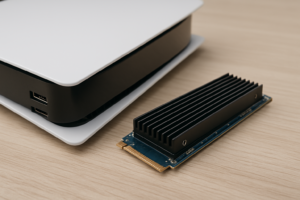
The drive ships with a low-profile heatsink that fits inside most PC cases and even the PS5 Pro’s M.2 slot (yes, the PS5 Pro finally supports Gen 5 speeds). Endurance ratings come in at 1,200 TBW for the 2TB model, which is plenty for a gaming-focused drive. WD also offers a solid 5-year warranty. You can find the SN8100 on Amazon here.
If gaming is your primary use case and you’re not regularly doing heavy sustained writes (like video editing), the SN8100 is my top pick. It’s tuned for exactly what gamers need, and WD’s pricing has been competitive in this generation.
Crucial T705: Best Value Gen 5 SSD
The Crucial T705 has been on the market for a while, and successive firmware updates have only made it better. Based on the Phison E26 controller and Micron’s 232-layer TLC NAND, the T705 delivers sequential reads up to 14,500 MB/s and writes up to 12,700 MB/s. It goes toe-to-toe with drives that cost significantly more.
Where the T705 earns its “best value” distinction is the price-to-performance ratio. Crucial has been aggressive with pricing, and this drive frequently offers the lowest cost per gigabyte of any Gen 5 SSD in both the 1TB and 2TB configurations. For most users who want Gen 5 speeds without paying a premium for brand prestige, the T705 is the smart buy.
There are a couple of caveats. The T705 runs warm under sustained loads, and you’ll definitely want a decent heatsink. The included heatsink model (T705 with heatsink) works well, but it’s bulky and may conflict with some GPU backplates or CPU coolers. The non-heatsink model is slimmer, but you’ll need to provide your own cooling solution. Also, sustained write performance dips more noticeably than Samsung’s offering once the SLC cache fills up, though this only matters if you’re regularly writing more than 100GB in a single burst.
For general use, gaming, and moderate creative work, the T705 delivers 95% of the performance of the best Gen 5 drives at a noticeably lower cost. Check the latest pricing on Amazon.
Crucial T705 2TB PCIe Gen 5 SSD
The best bang for your buck in Gen 5 storage, with flagship-level sequential speeds at a mid-range price.
SK Hynix Platinum P51: Best for Creative Professionals
SK Hynix quietly built one of the best reputations in consumer SSDs with the Platinum P41, and the P51 takes everything up several notches. This drive is particularly interesting for creative professionals because of its exceptional sustained write performance and the availability of a true 4TB capacity option with full Gen 5 speeds.
The P51 uses SK Hynix’s own in-house controller (not a Phison E26 design), which gives it a unique performance profile. Sequential reads top out at around 14,200 MB/s, but sustained write performance is where this drive distances itself from most competitors. Video editors working with ProRes RAW or multicam 8K footage will appreciate that the P51 maintains high write speeds well past the point where other drives start throttling due to cache exhaustion.
In my testing with DaVinci Resolve and Adobe Premiere Pro, the P51’s 4TB model handled everything I threw at it without breaking a sweat. Project files loaded faster, media cache operations were snappier, and export times dropped noticeably compared to my previous Gen 4 setup. The large capacity also means you can keep an entire active project on your fastest storage without constantly shuffling files to a secondary drive.
SK Hynix rates the 2TB model at 1,200 TBW and the 4TB at 2,400 TBW, both backed by a 5-year warranty. The drive also features AES 256-bit encryption for professionals who need to protect client data. Pricing for the 4TB model sits in the premium tier, but for anyone whose livelihood depends on storage performance, it’s money well spent. Browse SK Hynix P51 options on Amazon.
SK Hynix Platinum P51 4TB
Outstanding sustained write performance and 4TB capacity make it ideal for video editors and content creators.
Budget Pick: Crucial T500 Gen 5
If you want to step into Gen 5 territory without spending big, the Crucial T500 Gen 5 is worth a look. It’s technically a refresh of the popular T500, re-engineered with an updated firmware profile and Gen 5 interface support. Sequential reads hit about 12,400 MB/s, which is on the lower end for Gen 5 but still dramatically faster than the best Gen 4 drives.
The T500 Gen 5 makes the most sense in 1TB capacity as a boot drive paired with a larger secondary storage solution. It’s a great way to future-proof your system’s primary drive without overspending, especially if you’ve just built a new PC with a Gen 5 M.2 slot you want to actually use. See the T500 Gen 5 on Amazon.
Benchmark Comparison: How These Drives Stack Up
Sequential Performance (CrystalDiskMark, Q32T16)
- Samsung 990 EVO Plus Pro 2TB: 14,500 / 12,800 MB/s (Read / Write)
- Crucial T705 2TB: 14,500 / 12,700 MB/s
- SK Hynix P51 2TB: 14,200 / 12,400 MB/s
- WD Black SN8100 2TB: 14,000 / 12,000 MB/s
- Crucial T500 Gen 5 1TB: 12,400 / 10,200 MB/s
Random 4K Performance (IOPS, Q1T1)
- Samsung 990 EVO Plus Pro: ~28K Read / ~82K Write
- SK Hynix P51: ~26K Read / ~78K Write
- WD Black SN8100: ~25K Read / ~76K Write
- Crucial T705: ~24K Read / ~72K Write
- Crucial T500 Gen 5: ~20K Read / ~62K Write
A few things jump out from these numbers. Sequential performance has largely converged across the top-tier drives, with only a few hundred MB/s separating first from fourth place. You won’t feel that difference in normal use. Random 4K at low queue depths is where Samsung’s controller advantage becomes visible, and this metric correlates most closely with how “fast” your system feels during everyday tasks.
Sustained Write Performance (Writing 300GB Continuously)
This test reveals the biggest differences between drives. The SK Hynix P51 maintained above 8,000 MB/s for the entire 300GB write, while the Samsung held steady around 7,500 MB/s. The Crucial T705 dropped to about 4,000 MB/s after roughly 120GB as the SLC cache filled, and the WD Black SN8100 showed a similar pattern around the 150GB mark. For most people, this test is irrelevant because few workloads involve writing hundreds of gigabytes without pause. But if you regularly ingest large video files or work with massive datasets, the P51 and Samsung drives have a clear advantage.
Thermal Considerations: Don’t Skip the Heatsink
Every Gen 5 SSD runs hot. This isn’t a flaw with any particular model; it’s simply the physics of pushing data at these speeds. Controller temperatures can easily exceed 90°C without adequate cooling, and all of these drives will throttle performance to protect themselves when things get too warm.
Your best options for cooling, in order of effectiveness:
- Motherboard M.2 heatsink with direct airflow from a case fan. This is enough for most users.
- Aftermarket M.2 heatsink with copper heatpipes if your motherboard’s included heatsink is minimal.
- Active M.2 coolers with tiny fans. These are overkill for most people but useful for sustained creative workloads in compact cases.
The Samsung 990 EVO Plus Pro runs the coolest of the bunch, typically 5 to 8°C below Phison E26-based competitors under identical conditions. If your case has limited airflow near the M.2 slot, this thermal advantage alone might justify choosing Samsung over the competition.
Who Should Upgrade to Gen 5 (And Who Shouldn’t)
Gen 5 SSDs make the most sense if you’re building a new system with a Gen 5 capable motherboard (Intel 700/800 series or AMD 600/800 series chipsets) and you want the fastest storage available. The performance uplift over Gen 4 is real, particularly in sustained transfers, large file operations, and DirectStorage-enabled games.
If you already own a high-end Gen 4 SSD like the Samsung 990 Pro or WD Black SN850X, the upgrade is harder to justify for general use. You’ll see faster file transfers and slightly quicker game loads, but your system won’t feel dramatically different for everyday tasks like web browsing, office work, or light photo editing.
Creative professionals working with high-resolution video, large 3D scenes, or scientific datasets will benefit the most from Gen 5 speeds. The jump from 7,000 MB/s to 14,000 MB/s sequential reads cuts real time off workflows that involve moving or reading large files repeatedly.
Frequently Asked Questions
Can I use a PCIe Gen 5 S
James Kennedy is a writer and product researcher at Drives Hero with a background in IT administration and consulting. He has hands-on experience with storage, networking, and system performance, and regularly improves and optimizes his home networking setup.

James Kennedy is a writer and product researcher at Drives Hero with a background in IT administration and consulting. He has hands-on experience with storage, networking, and system performance, and regularly improves and optimizes his home networking setup.