USB 3.0 vs USB-C for External Storage: Speed Test Results
I recently spent a weekend transferring about 4TB of video footage between drives, and it reminded me just how much your connector type matters. What should have been a quick backup session turned into hours of waiting, all because I grabbed the wrong cable off my desk.
The USB 3.0 vs USB-C debate confuses a lot of people, partly because the naming conventions are a mess and partly because “USB-C” doesn’t actually tell you how fast something is. It only describes the physical shape of the connector. I’m going to break down real transfer speeds, explain what actually determines your performance, and help you pick the right external storage setup for your needs.
I’ve tested dozens of external drives over the past few years, from budget portable HDDs to high-end NVMe enclosures. The speed differences can be dramatic, and they don’t always line up with what the marketing materials promise.
Understanding the Terminology (Because It’s a Mess)
Before we look at speed numbers, we need to clear up some confusion. USB 3.0, USB 3.1, USB 3.2, and USB-C are not all describing the same thing. USB 3.0, 3.1, and 3.2 refer to the data transfer protocol. USB-C refers to the physical connector shape. You can have a USB-C port that only runs at USB 2.0 speeds, and you can have a USB 3.0 connection using the old rectangular Type-A plug.
Here’s a quick reference for the speed tiers:
- USB 3.0 (USB 3.2 Gen 1): Up to 5 Gbps theoretical maximum
- USB 3.1 (USB 3.2 Gen 2): Up to 10 Gbps theoretical maximum
- USB 3.2 Gen 2×2: Up to 20 Gbps theoretical maximum
- USB4 / Thunderbolt 3: Up to 40 Gbps theoretical maximum
The USB-IF (the organization behind USB standards) has renamed these protocols multiple times, which is why you’ll see the same speed called different things depending on when the product was released. For this article, I’ll stick with the most commonly used names to keep things clear.
Real-World Speed Test Results
Theoretical maximums are nice for spec sheets, but they don’t reflect what you’ll actually experience. I tested several popular drives using CrystalDiskMark for synthetic benchmarks and timed large file transfers (a 50GB folder of mixed video files) for real-world results.
USB 3.0 (5 Gbps) with Type-A Connector
Using a standard USB 3.0 portable HDD like the WD Elements, sequential read speeds topped out around 120-130 MB/s. That’s actually limited by the hard drive’s spinning platters, not the USB protocol. Swapping in a SATA SSD inside a USB 3.0 enclosure pushed speeds to about 400-440 MB/s, which is where USB 3.0’s real-world ceiling sits.
My 50GB test folder took approximately 6 minutes and 45 seconds with the SATA SSD over USB 3.0. With the portable HDD, it ballooned to about 8 minutes due to the slower drive mechanics.
USB 3.2 Gen 2 (10 Gbps) with USB-C Connector
This is where things get interesting. A Samsung T7 Shield connected via USB-C at 10 Gbps delivered sequential reads around 950-1,000 MB/s and writes around 900-950 MB/s. The same 50GB transfer completed in about 55 seconds. That’s a massive improvement.
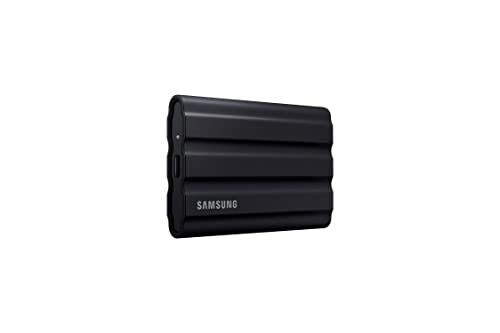
Samsung T7 Shield 2TB Portable SSD
Excellent balance of speed, durability, and portability with IP65 water and dust resistance
Keep in mind that this speed boost only materialized because the drive itself (an NVMe-based SSD) could keep up with the faster protocol. If you plug a traditional hard drive into a USB-C port running at 10 Gbps, you won’t see any improvement over USB 3.0 because the drive is the bottleneck.
USB 3.2 Gen 2×2 (20 Gbps) with USB-C
Drives like the WD Black P40 Game Drive that support 20 Gbps delivered reads around 1,800-2,000 MB/s in my testing. The 50GB transfer dropped to roughly 28 seconds. This protocol requires USB-C on both ends and a compatible host controller, which limits compatibility to newer PCs and laptops.
Thunderbolt 3/4 (40 Gbps) with USB-C
For the fastest results, I tested a SanDisk Professional PRO-G40 SSD over Thunderbolt 3. Sequential reads hit about 2,700 MB/s. My 50GB test folder transferred in approximately 20 seconds. The drive uses the same USB-C connector shape but communicates over the Thunderbolt protocol when connected to a Thunderbolt-capable port.
Speed Comparison Summary
Here’s how the numbers stack up in practical terms:
- USB 3.0 with HDD: ~120 MB/s (50GB in ~7 minutes)
- USB 3.0 with SATA SSD: ~430 MB/s (50GB in ~2 minutes)
- USB 3.2 Gen 2 with NVMe SSD: ~950 MB/s (50GB in ~55 seconds)
- USB 3.2 Gen 2×2 with NVMe SSD: ~1,900 MB/s (50GB in ~28 seconds)
- Thunderbolt 3 with NVMe SSD: ~2,700 MB/s (50GB in ~20 seconds)
The takeaway here is clear: the connector type alone doesn’t determine speed. It’s the combination of the USB protocol version AND the drive technology that matters. A USB-C connector running USB 3.0 with an HDD inside won’t outperform a USB Type-A connector running the same protocol with the same drive.
Compatibility: Where Things Get Tricky
USB 3.0 Type-A ports are still everywhere. Your desktop, your older laptop, your TV, your gaming console, your car. If you need a drive that works with everything, USB 3.0 Type-A compatibility is essential.
USB-C is rapidly becoming the default on new laptops and tablets, especially after the EU mandated USB-C for electronic devices. Apple’s entire MacBook lineup has been USB-C/Thunderbolt only for years. Most Windows ultrabooks have shifted to USB-C as well, though many still include at least one Type-A port.
The Adapter Situation
If you’re working across devices with different ports, you’ll need adapters or dual-interface cables. Here are my recommendations based on common scenarios:
Scenario 1: You have a USB-C drive but need to connect to older USB-A ports. A simple USB-C to USB-A adapter works perfectly. The nonda USB-C to USB 3.0 Adapter is tiny, reliable, and easy to keep on your keychain. Just know that you’ll be limited to USB 3.0 (5 Gbps) speeds through the Type-A port regardless of the drive’s capability.
Scenario 2: You have a USB-A drive but want to use USB-C ports. Grab a USB-A to USB-C adapter. Again, speeds will max out at whatever the drive’s USB protocol supports.
Scenario 3: You regularly switch between USB-A and USB-C devices. Your best bet is buying a drive that ships with both cable types or includes a dual-connector cable. The Samsung T7 series includes both USB-C to C and USB-C to A cables in the box, which is genuinely helpful.
Scenario 4: You need maximum speed across multiple devices. Consider a Thunderbolt-compatible dock or hub. The CalDigit TS4 Thunderbolt 4 Dock gives you multiple high-speed ports and backward compatibility. It’s a premium product, but for professional workflows, it’s worth investigating.
What About Power Delivery?
One advantage USB-C has beyond data speeds is power delivery. USB-C can deliver up to 240W of power with the latest PD 3.1 specification, though most external drives only need a fraction of that. This means USB-C drives can reliably pull enough bus power for NVMe SSDs without needing a separate power adapter.
USB 3.0 Type-A ports deliver up to 4.5W (900mA at 5V), which is usually sufficient for portable SSDs and 2.5-inch HDDs. However, some power-hungry drives, particularly 3.5-inch desktop externals, still need their own AC adapter regardless of which USB connector they use.
Future-Proofing: My Honest Recommendation
If you’re buying an external drive today and plan to use it for the next 3-5 years, go with a USB-C drive that supports at least USB 3.2 Gen 2 (10 Gbps). USB-C is clearly the direction the industry is heading, and 10 Gbps is the sweet spot where you get meaningful speed improvements without paying a premium for 20 Gbps or Thunderbolt support that most people don’t need.
For most people, I recommend the Samsung T7 or T7 Shield as an all-around portable SSD. It’s fast, well-built, includes both cable types, and works with virtually every modern device.
For power users handling large video files, game libraries, or frequent backups of massive datasets, stepping up to a 20 Gbps or Thunderbolt drive makes sense. The SanDisk Professional PRO-G40 SSD supports both USB 3.2 Gen 2 and Thunderbolt 3, giving you flexibility and top-tier speed.
SanDisk Professional PRO-G40 2TB SSD
Dual Thunderbolt 3 and USB 3.2 Gen 2 support makes this ideal for creative professionals who need maximum speed and broad compatibility
If budget is a concern and you primarily back up documents, photos, and moderate file collections, a USB 3.0 portable HDD still gets the job done. It’ll just take longer. Something like the WD Elements Portable HDD in a larger capacity remains a solid choice for bulk storage where speed isn’t critical.
Common Mistakes to Avoid
After helping friends and family choose external drives for years, I see the same errors pop up repeatedly.
Assuming USB-C means fast. I can’t stress this enough. The connector shape doesn’t guarantee speed. Always check the specific USB protocol version (Gen 1, Gen 2, etc.) in the product specs.
Using the wrong cable. A USB 2.0 cable with USB-C connectors will limit your fancy NVMe SSD to USB 2.0 speeds (480 Mbps). Always use the cable that came with your drive, or verify that a replacement cable supports the data rate you need.
Ignoring your computer’s port capabilities. Your drive can only transfer as fast as the slowest link in the chain. A 40 Gbps Thunderbolt drive connected to a USB 3.0 port will run at 5 Gbps. Check your computer’s specifications before buying a high-speed drive you can’t fully use.
Buying more speed than your drive can deliver. Putting a SATA SSD in a 10 Gbps NVMe enclosure won’t make the SATA drive faster. SATA SSDs top out around 550 MB/s regardless of the enclosure. Match the enclosure protocol to the drive inside it.
Frequently Asked Questions
Can I use a USB-C external drive with my older computer that only has USB-A ports?
Absolutely. You just need a USB-C to USB-A cable or a small adapter. Most portable SSDs include both cable types in the box. Your speed will be limited to whatever USB version your computer’s Type-A port supports (usually USB 3.0 at 5 Gbps), but the drive will work perfectly fine. Data transfer is fully backward compatible across all USB versions.
Is USB-C the same as Thunderbolt?
Not exactly. Thunderbolt 3 and Thunderbolt 4 use the USB-C connector shape, but they’re a different, faster protocol developed by Intel. A Thunderbolt port can accept USB-C devices, and a Thunderbolt drive will work in a USB-C port (at reduced USB speeds). However, a standard USB-C port won’t deliver Thunderbolt speeds to a Thunderbolt drive. Look for the lightning bolt icon next to your port to confirm Thunderbolt support.
Will USB 3.0 become obsolete soon?
USB 3.0 at 5 Gbps isn’t going anywhere in the near term. It’s built into billions of devices, and for many use cases (especially with HDDs that can’t saturate the bandwidth anyway) it’s perfectly adequate. You’ll continue to see Type-A USB 3.0 ports on desktops, monitors, and hubs for years to come. For new purchases, USB-C is the smarter bet, but your existing USB 3.0 drives won’t become useless overnight.
Do I need a special cable for USB 3.2 Gen 2 (10 Gbps) speeds?
Yes. You need a cable rated for the speed you want. Cables marked as “USB 3.2 Gen 2” or “10 Gbps” will work. For 20 Gbps (Gen 2×2), you need a cable specifically rated for that speed, and these are less common. Thunderbolt cables are typically rated for 40 Gbps. When in doubt, use the cable included with your drive. Cheap, unrated USB-C cables from the junk drawer are one of the most common reasons people see disappointing transfer speeds.
Final Verdict
For the vast majority of people buying external storage in 2024 and beyond, a USB-C drive with USB 3.2 Gen 2 (10 Gbps) support is the right call. It offers a meaningful speed upgrade over USB 3.0, works with modern laptops and desktops, and can always connect to older USB-A ports with an inexpensive adapter.
Samsung T7 Shield 1TB Portable SSD
Our top overall recommendation for most users: fast 10 Gbps transfers, IP65 rated durability, and includes both USB-C and USB-A cables
Don’t overthink the connector type. Focus on matching the USB protocol version to your actual needs and making sure

James Kennedy is a writer and product researcher at Drives Hero with a background in IT administration and consulting. He has hands-on experience with storage, networking, and system performance, and regularly improves and optimizes his home networking setup.