Best Encrypted Flash Drives for Sensitive Files
Carrying sensitive files on a USB drive feels like walking around with an unlocked safe. One lost drive at a coffee shop, one forgotten stick in a hotel business center, and your tax returns, client contracts, or medical records are out in the wild. Software encryption helps, but it can be bypassed, misconfigured, or simply forgotten. Hardware-encrypted flash drives solve this problem at the silicon level, and they’ve gotten remarkably good in the last couple of years.
I’ve tested and compared the most popular hardware-encrypted USB drives on the market, from the Kingston IronKey lineup to Apricorn’s Aegis series and a few options in between. This guide covers what actually matters: FIPS certification levels, real-world transfer speeds, daily usability quirks, and which drive makes sense for your specific situation.
Why Hardware Encryption Beats Software Encryption
Software-based encryption tools like BitLocker and VeraCrypt are useful, but they rely on your computer’s processor to handle the encryption workload. This means the encrypted volume is only as secure as the host machine. If your laptop has malware running in the background, a keylogger can capture your password before the encryption even kicks in.
Hardware-encrypted drives handle all cryptographic operations on a dedicated processor built into the drive itself. Your encryption key never leaves the device and never touches your computer’s RAM. This is a critical distinction for anyone handling regulated data under HIPAA, GDPR, or SOX compliance requirements.
There’s also a practical benefit: hardware-encrypted drives work across operating systems without installing any software. Plug one into a Windows PC, a Mac, or a Linux machine, enter your PIN or password, and you’re in. No drivers, no admin privileges, no compatibility headaches. If you’ve ever tried to open a VeraCrypt volume on a locked-down corporate laptop, you’ll appreciate this immediately.
Understanding FIPS Certification (And Why It Matters)
You’ll see “FIPS 140-2” and “FIPS 140-3” mentioned constantly when shopping for encrypted drives. FIPS stands for Federal Information Processing Standards, and these certifications are issued by NIST (National Institute of Standards and Technology) after rigorous third-party testing. They’re not marketing fluff.
FIPS 140-2 Level 2 vs. Level 3
Level 2 requires evidence of tampering to be visible (tamper-evident coatings or seals) and role-based authentication. Most business-grade encrypted drives meet this standard. It’s sufficient for the majority of corporate and healthcare use cases.
Level 3 adds physical tamper-resistance, meaning the device must actively resist and respond to physical intrusion attempts. If someone tries to pry open a Level 3 certified drive to access the memory chips directly, the device will zeroize (destroy) the encryption keys. This is the level required by many government agencies and military contractors.
FIPS 140-3: The Newer Standard
FIPS 140-3 became effective in 2019 and is gradually replacing 140-2 for new certifications. It aligns with international standards (ISO/IEC 19790) and introduces stricter requirements for cryptographic algorithm testing. If you’re buying a drive today for long-term compliance needs, look for FIPS 140-3 certification when available. Kingston’s newest IronKey models have already made this transition.
Top Encrypted Flash Drives Compared
Let’s break down the best options currently available, organized by who they’re best suited for.
Kingston IronKey Vault Privacy 50 Series
The Kingston IronKey Vault Privacy 50 (VP50) is the sweet spot for most professionals who need certified encryption without an extreme price premium. It uses AES-256 hardware encryption in XTS mode, supports complex passwords with multi-password options (Admin, User, and one-time recovery), and is FIPS 197 certified.
What I like about the VP50 is the multi-password system. You can set an Admin password and a separate User password, which is genuinely useful in enterprise settings where IT needs a recovery option. There’s also a brute-force lockout: after a configurable number of wrong attempts, the drive crypto-erases itself. Transfer speeds are reasonable at up to 250 MB/s read and 180 MB/s write (USB 3.2 Gen 1), which is plenty fast for document-heavy workflows. Available in capacities from 8GB to 256GB.

Kingston IronKey Vault Privacy 50 USB Drive
Best all-around encrypted flash drive for professionals who need strong encryption with excellent usability and multi-password support.
If you’re also considering portable SSDs for travel and want to compare your options for larger file storage, check out our guide to the best portable SSDs for travel in 2026, though keep in mind most portable SSDs rely on software encryption rather than dedicated hardware encryption.
Kingston IronKey Keypad 200
The Kingston IronKey Keypad 200 (KP200) takes a different approach. Instead of entering a password on your computer, you type a PIN directly on the drive’s built-in alphanumeric keypad. This makes it OS-independent in the truest sense, because you never type your credentials on a potentially compromised machine.
The KP200 carries FIPS 140-3 Level 3 certification, the highest level commonly available in a USB flash drive form factor. The drive’s circuitry is coated in epoxy to prevent physical tampering, and the keypad itself uses a polymer coating so worn keys don’t reveal your PIN over time. It supports USB 3.2 Gen 1 with speeds up to 145 MB/s read and 115 MB/s write.
The tradeoff is size. The keypad makes this drive noticeably larger than a standard USB stick. It won’t fit comfortably on a keychain, and it sticks out awkwardly from some laptops. But if you need FIPS 140-3 Level 3 certification, or if you regularly use untrusted computers (hotel lobbies, conference kiosks), the hardware keypad is a significant security advantage.
Apricorn Aegis Secure Key 3NXC
Apricorn is the other major player in hardware-encrypted portable storage, and the Apricorn Aegis Secure Key 3NXC is their flagship USB-C encrypted flash drive. Like the IronKey Keypad 200, it features an onboard keypad for PIN entry, FIPS 140-2 Level 3 validation, and AES-256 XTS hardware encryption.
Where Apricorn differentiates itself is in the Admin features. The Aegis Secure Key supports configurable brute-force protection, forced enrollment (so the first user must create a new PIN rather than using a default), and a read-only mode that prevents malware from being written to the drive. There’s also a “Unattended Auto-Lock” feature that locks the drive after a set period of inactivity.
The USB-C connector is a welcome upgrade. Most encrypted flash drives still ship with USB-A, which is increasingly inconvenient as laptops drop their Type-A ports. Apricorn also makes a USB-A version (the Aegis Secure Key 3NX) if you need legacy compatibility. Capacities range from 4GB to 128GB.

Apricorn Aegis Secure Key 3NXC USB-C
Best USB-C encrypted flash drive with onboard keypad, FIPS 140-2 Level 3 certification, and excellent admin controls for enterprise deployment.
iStorage datAshur PRO2
The iStorage datAshur PRO2 is a strong contender from a UK-based company that specializes in encrypted storage. It features FIPS 140-2 Level 3 certification, an onboard alphanumeric keypad, and a rugged aluminum casing with IP68 dust and water resistance (certified to withstand submersion up to 1.5 meters).
The datAshur PRO2 supports independent Admin and User PINs (7-15 digits), configurable brute-force attack defense, and a self-destruct PIN that immediately crypto-erases the drive. It’s available in capacities from 4GB to 512GB, with the higher-capacity models appealing to users who need to transport large datasets securely. Read speeds reach up to 130 MB/s and write speeds up to 116 MB/s on USB 3.0.
One genuine advantage of iStorage drives is their durability rating. If you work in harsh environments (construction sites, field research, military operations), the IP68 rating and MIL-STD-810F compliance give the datAshur PRO2 an edge over competitors with less rugged builds.
Verbatim Keypad Secure
For a more budget-conscious option, the Verbatim Keypad Secure drive offers AES-256 hardware encryption with an onboard keypad at a lower price point than the Kingston and Apricorn options. It doesn’t carry FIPS certification, which makes it unsuitable for regulated industries, but for personal use or small business scenarios where you need solid encryption without compliance paperwork, it gets the job done.
The Verbatim supports USB 3.2 Gen 1, offers capacities from 32GB to 128GB, and works across Windows, macOS, and Linux without drivers. Build quality is adequate but not exceptional; this is clearly a consumer-grade product rather than a mil-spec device. If you don’t need FIPS certification, it’s worth a look.
Real-World Usability: What Nobody Tells You
Encrypted drives add friction to your daily workflow, and it’s important to understand that before buying. Here’s what I’ve noticed after using these drives extensively.
Keypad drives are slower to access. Every time you unplug and replug a keypad-equipped drive, you need to re-enter your PIN before the computer can see the storage volume. This takes 5-10 seconds and gets tedious when you’re moving between machines frequently. Password-based drives like the IronKey VP50 are slightly faster since you type the password in a software prompt, though this introduces the keylogger vulnerability that keypad drives avoid.
Capacity matters more than you think. Hardware-encrypted drives cost significantly more per gigabyte than standard USB drives. You might be tempted to save money by buying the smallest capacity available, but running out of space on a secure drive creates problems. You’ll end up splitting files across multiple locations, which increases your attack surface. Buy at least double the capacity you think you need.
Forgetting your PIN is catastrophic. With FIPS-certified drives, there is no backdoor. If you forget your Admin and User credentials and exhaust all recovery attempts, the drive crypto-erases itself. Your data is gone permanently. This is a feature, not a bug, but it catches people off guard. Write down your recovery credentials and store them in a separate secure location (a safe, a password manager, not a sticky note on your monitor).
Before you repurpose or sell any storage device, encrypted or not, make sure you understand how to securely wipe your drive. Even encrypted drives should be properly wiped to reset admin credentials and remove any trace of your data.
Hardware Encryption vs. Encrypted Portable SSDs
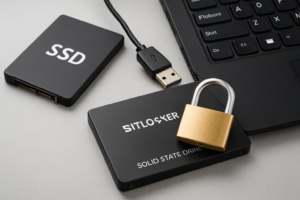
If you need more storage than a flash drive offers (most top out at 128-512GB), you might consider a hardware-encrypted portable SSD. The Kingston IronKey Vault Privacy 80ES is a portable SSD with a touchscreen for passcode entry, available in capacities up to 7.68TB. Apricorn makes the Aegis Fortress L3 SSD with similar keypad-based authentication in SSD form.
These encrypted portable SSDs are substantially faster than encrypted flash drives (often 300+ MB/s vs. 100-250 MB/s) and offer much larger capacities. The downside is that they’re physically bigger and more expensive. For most people carrying documents, contracts, and spreadsheets, an encrypted flash drive in the 32-128GB range is more practical. If you’re moving video files, database backups, or disk images, an encrypted portable SSD makes more sense.
When choosing between cloud storage and a physical encrypted drive, your decision should factor in accessibility, internet dependency, and ongoing costs. Our comparison of cloud backup vs. local NAS storage costs can help frame that decision, especially if you’re weighing encrypted physical storage against encrypted cloud solutions.
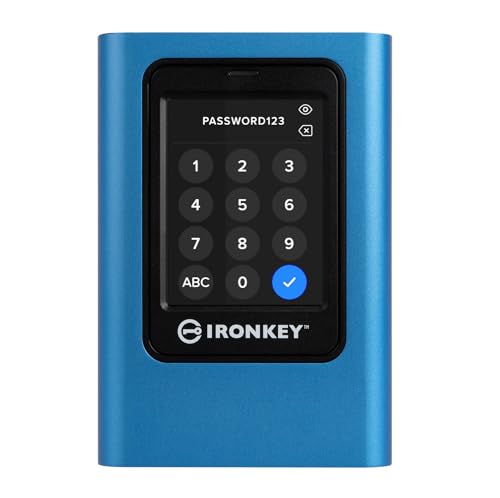
Kingston IronKey Vault Privacy 80 External SSD
Best option if you need hardware-encrypted portable storage with large capacity and a touchscreen interface for PIN entry.
Which Encrypted Drive Should You Buy?
Here’s my recommendation broken down by use case:
- For most professionals and business users: The Kingston IronKey Vault Privacy 50 offers the best balance of security, speed, usability, and value. Its multi-password system and FIPS 197 certification cover most compliance requirements outside of government/military.
- For government, military, or maximum security needs: The Kingston IronKey Keypad 200 with FIPS 140-3 Level 3 is the top choice. The hardware keypad eliminates host-based attack vectors entirely.
- For USB-C users who want enterprise admin features: The Apricorn Aegis Secure Key 3NXC is the best USB-C encrypted drive available, with excellent policy management for IT departments.
- For harsh environments: The

James Kennedy is a writer and product researcher at Drives Hero with a background in IT administration and consulting. He has hands-on experience with storage, networking, and system performance, and regularly improves and optimizes his home networking setup.