Best 2-Bay NAS Devices for Home Users in 2026
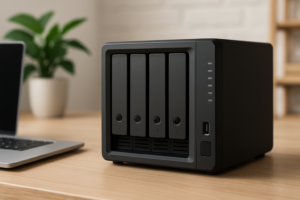
A 2-bay NAS is one of the smartest upgrades you can make for your home network. It gives you centralized storage for backups, a personal media server, and remote file access, all without paying monthly cloud fees. And because it only needs two drive bays, it stays compact, quiet, and affordable enough for most households.
But choosing the right one can be tricky. There are a handful of major brands making 2-bay NAS units, each with different processors, software ecosystems, and feature sets. I’ve spent weeks testing and researching the best options available in 2026, and this roundup covers the models that actually deserve your money. Whether you’re backing up family photos or streaming a Plex library, there’s a pick here for you.
Why a 2-Bay NAS Makes Sense for Home Users
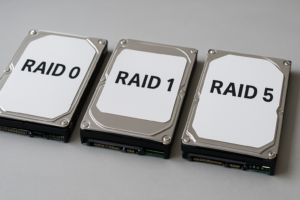
Before jumping into specific models, it’s worth understanding why two bays hit the sweet spot for most people. A single-bay NAS doesn’t let you use RAID mirroring, which means a single drive failure kills all your data. A 4-bay unit is overkill (and overpriced) for someone who just needs reliable home storage. Two bays give you the option to run RAID 1, which mirrors your data across both drives so you have automatic redundancy. If you’re unsure about how RAID 0 compares to RAID 1, it’s worth reading up before you configure your NAS for the first time.
With two bays and a pair of 8TB drives, you can get 8TB of protected storage (in RAID 1) or 16TB of raw storage (in RAID 0 or JBOD). For most families, that’s more than enough to store years of photos, documents, music, and even a healthy movie collection.
What to Look for in a Home NAS
Not all 2-bay NAS units are created equal. Here are the specs that matter most for home use:
- Processor and RAM: A quad-core ARM or Intel Celeron chip with at least 2GB of RAM handles file transfers and media transcoding smoothly. If you plan to run Plex with transcoding, lean toward Intel-based models.
- Software ecosystem: Synology’s DSM and QNAP’s QTS are the two heavyweights. Both offer app stores with hundreds of packages. Synology tends to be more polished and beginner-friendly, while QNAP gives more power-user options.
- Network speed: Most budget models include a single Gigabit Ethernet port (1GbE). Some newer units now ship with 2.5GbE, which makes a real difference for large file transfers if your router supports it.
- Drive compatibility: Confirm the unit supports both 3.5-inch HDDs and 2.5-inch SSDs. Some models also include M.2 NVMe slots for cache acceleration.
- Noise and power consumption: A home NAS runs 24/7 in many setups, so look for models that idle under 15 watts and produce less than 20 dB of noise.
If you’re still debating whether a NAS is worth it compared to cloud storage, our cloud backup vs. local NAS cost comparison breaks down the real numbers over time. Spoiler: the NAS pays for itself within a couple of years for most users.
Best 2-Bay NAS Devices for Home Users in 2026
1. Synology DiskStation DS224+ (Best Overall)
The DS224+ is the successor to the wildly popular DS223j and DS220+ line, and Synology has refined nearly everything. It runs an Intel Celeron J4125 quad-core processor paired with 2GB of DDR4 RAM (expandable to 6GB). This gives it enough muscle for Plex transcoding, Docker containers, and Synology’s excellent suite of backup and sync apps.
Synology’s DiskStation Manager (DSM 7.2) remains the gold standard for NAS operating systems. The interface is intuitive, updates are frequent, and the ecosystem of first-party apps (Synology Photos, Synology Drive, Hyper Backup) is genuinely impressive. You get features that rival paid cloud services, without the subscription.
The DS224+ includes two Gigabit Ethernet ports with link aggregation and a USB 3.2 Gen 1 port. It’s not the fastest NAS on this list in terms of raw network throughput, but the software experience more than makes up for it. For most home users who value reliability and ease of use above all else, this is my top pick.

Synology DiskStation DS224+ 2-Bay NAS
The best all-around 2-bay NAS for home users thanks to Synology’s polished DSM software and solid Intel hardware.
2. QNAP TS-233 (Best Budget Pick)
If you want a functional 2-bay NAS without spending much, the QNAP TS-233 deserves a serious look. It uses an ARM Cortex-A55 quad-core processor with 2GB of RAM, which handles basic file serving, photo backups, and light media streaming with no issues.
QNAP’s QTS operating system is feature-rich, though it has a steeper learning curve than Synology’s DSM. You get access to QNAP’s app center, which includes tools for surveillance, multimedia, and even virtual machines (though this hardware is too modest for VMs). The TS-233 also supports QNAP’s hybrid backup sync, which can push data to cloud providers as an extra layer of protection.
The trade-off is that the ARM processor can’t handle Plex transcoding. If you’re only doing direct play to modern smart TVs or streaming devices, that’s fine. But if you need on-the-fly transcoding for remote playback, you’ll want to step up to an Intel-based model. For pure backup and file storage at an entry-level price, the TS-233 is hard to beat.
3. Synology DiskStation DS223j (Best for Beginners)
The DS223j is Synology’s most affordable 2-bay unit, and it’s specifically designed for people who have never used a NAS before. It uses a Realtek RTD1619B quad-core ARM processor with 1GB of RAM, which keeps costs down but limits multitasking.
You still get the full DSM 7.2 experience, which means Synology Photos for automatic phone backup, Synology Drive for file syncing across devices, and Hyper Backup for scheduled drive snapshots. The setup wizard walks you through everything in about 15 minutes, and our beginner’s NAS setup guide covers additional tips to get your network storage running smoothly.
The DS223j won’t win any speed contests. File transfers top out around 112 MB/s on its single Gigabit Ethernet port, and the 1GB of non-expandable RAM means you shouldn’t try to run too many packages simultaneously. But for a household that just needs automated backups and basic file sharing, it does the job beautifully.
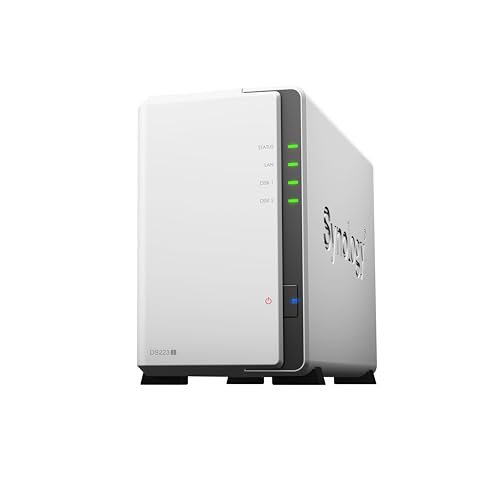
Synology DiskStation DS223j 2-Bay NAS
The simplest, most affordable entry point into Synology’s excellent ecosystem for first-time NAS owners.
4. QNAP TS-264 (Best for Power Users)
The TS-264 is a step above the competition in nearly every way. It runs an Intel Celeron N5095 quad-core processor, ships with 8GB of DDR4 RAM (expandable to 16GB), and includes two M.2 2280 NVMe SSD slots for cache acceleration. This is as powerful as 2-bay NAS units get in 2026.
The standout feature is the 2.5GbE Ethernet port, which more than doubles your maximum transfer speed compared to standard Gigabit models. If your router or switch supports 2.5GbE, you’ll see real-world file transfers north of 280 MB/s, making the TS-264 feel almost as fast as a directly connected external drive. HDMI 2.0 output lets you plug it directly into a TV for media playback, too.
QNAP’s QTS gives you Docker support, virtual machine capability, and a dizzying number of third-party apps. The TS-264 can genuinely function as a lightweight home server, running Pi-hole for ad blocking, a VPN server, and Plex with hardware transcoding simultaneously. It costs more than the other units on this list, but if you want room to grow, this is the one.
5. TerraMaster F2-223 (Best Value Intel NAS)
TerraMaster has been quietly improving its NAS lineup, and the F2-223 is a legitimate contender. It pairs an Intel Celeron N4505 dual-core processor with 4GB of DDR4 RAM, giving it enough power for Plex transcoding and Docker apps at a price that significantly undercuts Synology and QNAP equivalents.
The hardware is solid, but TerraMaster’s TOS (TerraMaster Operating System) is where things get a bit rough. It’s functional and has improved noticeably over the past year, but it still lacks the polish and app library of DSM or QTS. If you’re comfortable with a slightly less refined software experience and you want Intel-grade hardware without the premium price tag, the F2-223 offers genuine value.
It includes a 2.5GbE Ethernet port, which is a nice bonus at this price point. Tool-less drive installation makes swapping drives easy, and the metal chassis feels well-built. For a home media server on a tighter budget, this is a smart pick.

TerraMaster F2-223 2-Bay NAS
An affordable Intel-powered NAS with 2.5GbE networking, great for Plex and Docker without breaking the bank.
Which Drives Should You Use?
A NAS is only as good as the drives inside it. For a 2-bay home setup, I recommend NAS-rated 3.5-inch hard drives like the WD Red Plus or Seagate IronWolf series. These are designed for 24/7 operation, handle vibration better than desktop drives, and typically carry longer warranties.
For capacity, 4TB or 8TB drives tend to be the best bang for the buck in 2026. A pair of 8TB drives in RAID 1 gives you 8TB of mirrored, protected storage. If you’re curious about the trade-offs between SSDs and traditional hard drives for NAS storage, our SSD vs. HDD comparison covers the performance and longevity differences in detail.
Avoid using old desktop drives you have lying around. NAS-rated drives have firmware optimizations for RAID arrays, including better error recovery settings that prevent the NAS from dropping a drive during rebuilds. It’s worth the extra investment to get the right drives from the start.
Setting Up Your NAS for Home Backup
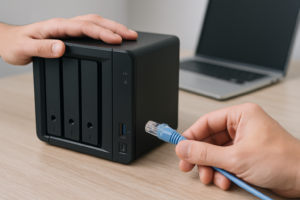
Once your NAS arrives, the initial setup usually takes less than 30 minutes. All five models on this list have browser-based setup wizards that detect the NAS on your network, format the drives, and create your initial shared folders.
Here’s a quick checklist for getting the most out of your new NAS right away:
- Configure RAID 1 mirroring for data protection. You lose half your total capacity, but your files survive a single drive failure.
- Set up automatic phone backup using Synology Photos, QNAP QuMagie, or a third-party app. Every photo and video from your phone gets backed up the moment you connect to your home Wi-Fi.
- Enable remote access through Synology QuickConnect, QNAP myQNAPcloud, or a VPN. This lets you access your files from anywhere without exposing your NAS directly to the internet.
- Schedule automated PC/Mac backups using Time Machine (for Mac) or Synology Active Backup (for Windows). Our guide on setting up automated NAS backups walks you through this in detail.
- Install Plex or Jellyfin if you want a home media server. Both are available as packages on Synology and QNAP app stores.
One important habit: keep your NAS firmware updated. Manufacturers regularly patch security vulnerabilities, and an internet-facing NAS with outdated software is an inviting target. Enable automatic update notifications at minimum.
Quick Comparison Table
| Model | Processor | RAM | Network | Best For |
|---|---|---|---|---|
| Synology DS224+ | Intel Celeron J4125 | 2GB (exp. 6GB) | 2x 1GbE | Best overall |
| QNAP TS-233 | ARM Cortex-A55 | 2GB | 1x 1GbE | Budget backup |
| Synology DS223j | Realtek RTD1619B | 1GB | 1x 1GbE | Beginners |
| QNAP TS-264 | Intel Celeron N5095 | 8GB (exp. 16GB) | 1x 2.5GbE | Power users |
 James Kennedy is a writer and product researcher at Drives Hero with a background in IT administration and consulting. He has hands-on experience with storage, networking, and system performance, and regularly improves and optimizes his home networking setup. Similar Posts |