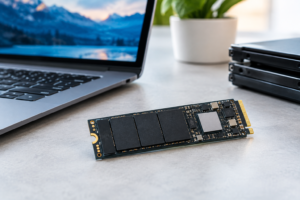
TLC NVMe SSDs With DRAM Cache
Why DRAM Cache Still Matters on a TLC NVMe Drive
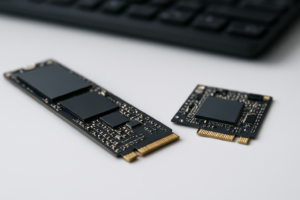
Not all NVMe SSDs are built the same way, even when they use the same TLC NAND flash. Some drives include a dedicated DRAM chip that stores the mapping table (the FTL, or flash translation layer) so the controller can find data instantly. Others skip the DRAM entirely and borrow a slice of your system’s RAM through Host Memory Buffer (HMB), which works fine for light use but tends to fall off a cliff during sustained writes or heavy multitasking.
This page is a reference, not a general explainer. If you want the deeper mechanics of how NVMe stacks up against older interfaces, check out our piece on whether NVMe is really faster than SATA SSDs. Here, we’re focused on which specific TLC drives actually carry DRAM, what NAND and controller each one uses, and where manufacturers quietly change hardware between capacities.
Samsung: 990 Pro and 980 Pro
Samsung’s own controllers and in-house V-NAND make these two of the more consistent DRAM-equipped lines on the market, though capacity still changes things.
- Samsung 990 Pro: Samsung Pascal controller, 7th-gen V-NAND TLC, LPDDR4 DRAM that scales with capacity (roughly 1GB of DRAM per 1TB of storage). PCIe 4.0 x4, NVMe 2.0. Available in 1TB, 2TB, and 4TB, with a 500GB version added later that carries proportionally less DRAM and noticeably lower sequential write speeds than the larger models.
- TBW ratings: 300TB (500GB), 600TB (1TB), 1200TB (2TB), 2400TB (4TB), backed by a 5-year warranty.
- Samsung 980 Pro: Elpis controller, 128-layer V-NAND TLC, LPDDR4 DRAM. PCIe 4.0 x4, NVMe 1.3c. The 250GB and 500GB models have fewer NAND dies in parallel, which drops peak sequential write speed to roughly half of what the 1TB and 2TB versions hit. TBW runs 150TB, 300TB, 600TB, and 1200TB across the four capacities, with a 5-year warranty on all of them.
Samsung 990 Pro NVMe SSD
Samsung’s fastest consumer drive with full DRAM cache scaling and a genuine 5-year warranty.
If you’re deciding between Samsung and another brand entirely, our WD Black vs Samsung SSD comparison goes into more detail on real-world differences beyond the spec sheet.
WD Black SN850X (and Why the SN770 Doesn’t Belong Here)
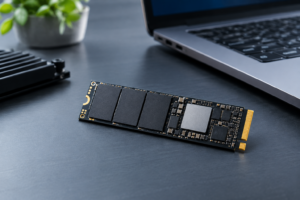
The WD Black SN850X is one of the better DRAM-backed TLC drives you can buy right now. It uses a Western Digital in-house controller paired with Kioxia BiCS5 112-layer TLC NAND, plus a dedicated DRAM buffer that scales with capacity. It runs on PCIe 4.0 x4 and is offered in 500GB, 1TB, 2TB, and 4TB capacities, including versions with a heatsink for PS5 compatibility.
The 500GB model is the odd one out. Fewer NAND dies mean it can’t hit the same sequential write speeds as the 1TB and larger versions, so if performance is the whole point of buying this drive, skip the smallest capacity. TBW ratings run 300TB, 600TB, 1200TB, and 2400TB across the lineup, all covered by a 5-year warranty.
Here’s the part that trips people up: the WD Black SN770, which sits right next to the SN850X on shelves and in search results, has no DRAM chip at all. It relies purely on HMB. We broke down exactly how that affects real workloads in our WD Black SN770 vs SN850X spec comparison, and it’s worth reading before you assume “WD Black” automatically means DRAM cache.
WD Black SN850X NVMe SSD
A genuinely DRAM-equipped PCIe 4.0 drive with strong sustained write performance and PS5-ready heatsink options.
Crucial T500 and Kingston Fury Renegade
Crucial’s T500 pairs Micron’s own 232-layer TLC NAND with a dedicated DRAM cache and a controller Crucial doesn’t publicly brand, but the performance profile (up to roughly 7,300 MB/s read) puts it firmly in flagship territory. It’s sold in 500GB, 1TB, 2TB, and 4TB capacities, with TBW ratings that scale from around 300TB up to 2400TB at the top end, and a 5-year warranty across the board. As with most drives on this list, the 500GB model trades some sustained write throughput for its lower price point.
Kingston’s Fury Renegade uses the Phison E18 controller matched with Micron 176-layer TLC NAND and onboard DDR4 DRAM. It’s a PCIe 4.0 x4 drive available from 500GB up to 4TB. Kingston actually rates endurance higher than many competitors at similar capacities, with TBW figures around 400TB, 800TB, 1600TB, and 3200TB, backed by a 5-year warranty. The 500GB variant again has a visibly lower sequential write ceiling than the 1TB and up models, a pattern you’ll see across nearly every drive in this category.
Seagate FireCuda 530 and Sabrent Rocket 4 Plus
Both of these also lean on the Phison E18 controller, which has become the default choice for third-party TLC drives that want full DRAM support without designing a controller in-house.
- Seagate FireCuda 530: Phison E18 controller, Micron 176-layer TLC NAND, dedicated DRAM cache, PCIe 4.0 x4. Capacities span 500GB to 4TB. TBW ratings are aggressive for the category, running up to around 2800TB on the 4TB model, and Seagate backs it with a 5-year warranty plus a limited data recovery service.
- Sabrent Rocket 4 Plus: Phison E18 controller, TLC NAND (sourced from multiple suppliers depending on production batch), DRAM cache present across the lineup. PCIe 4.0 x4, with capacities up to 8TB. Sabrent’s warranty and TBW figures are competitive but worth double-checking per capacity before buying, since Sabrent has swapped NAND vendors between production runs more often than Samsung or WD.
If your use case is more about general performance than exact model shopping, our guide on what NVMe SSDs are actually used for covers which workloads benefit most from DRAM cache versus HMB.
How to Pick Between These
For most people building a gaming PC or workstation, the Samsung 990 Pro and WD Black SN850X are the safest picks because both companies control their own NAND and firmware, which means fewer surprise component swaps between batches. If endurance matters more than raw speed, the Kingston Fury Renegade and Seagate FireCuda 530 both offer higher TBW per dollar at the same capacity tier.
Avoid buying the smallest capacity (250GB or 500GB) in any of these lines if performance is your priority. Every manufacturer here reduces NAND die parallelism at the low end, which drops sequential write speeds noticeably even though the DRAM cache and controller stay the same.
Kingston Fury Renegade NVMe SSD
Phison E18 plus DRAM cache with some of the highest TBW ratings in its class.
Curious how any of these compare against SATA drives or older Intel-branded SSDs still floating around in budget builds? Our NVMe SSD vs Intel SSD breakdown and SATA vs NVMe for gaming comparison both cover that ground in more detail.
Frequently Asked Questions
Does every TLC NVMe SSD have DRAM cache?
No. Plenty of popular TLC drives, including the WD Black SN770 and Crucial P3 Plus, skip DRAM entirely and use HMB instead. TLC NAND type tells you nothing about DRAM presence on its own, you have to check the controller and cache design for each specific model.
Does DRAM cache actually make a noticeable difference?
Yes, especially under sustained writes, large file transfers, or heavy multitasking where the FTL mapping table needs constant, fast updates. For light everyday use like web browsing and document editing, HMB drives can feel nearly identical, but DRAM-equipped drives hold up better under pressure and typically sustain performance longer before thermal or cache exhaustion kicks in.
Do smaller capacities of the same SSD model perform the same as larger ones?
Usually not. Manufacturers reduce the number of NAND dies at lower capacities, which cuts into parallelism and lowers sequential write speeds, sometimes by half. DRAM size often shrinks proportionally too. Always check the spec sheet for your exact capacity rather than assuming the reviewed 1TB or 2TB numbers apply to the 500GB version.
This article contains affiliate links. We may earn a small commission at no extra cost to you.

James Kennedy is a writer and product researcher at Drives Hero with a background in IT administration and consulting. He has hands-on experience with storage, networking, and system performance, and regularly improves and optimizes his home networking setup.