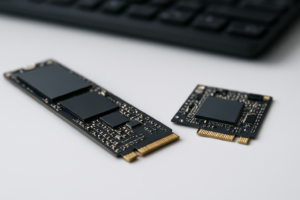
NVMe SSDs With DRAM Cache: Complete List
Not every NVMe drive labeled “high performance” actually has a physical DRAM chip on the board. Some rely entirely on Host Memory Buffer (HMB), which borrows a sliver of your system’s RAM instead of using dedicated cache. That difference matters a lot for sustained writes, heavy multitasking, and how a drive behaves once it’s mostly full. Below is a verified list of NVMe SSDs that actually include onboard DRAM, along with the specs that separate one capacity from another.
Why DRAM Cache Still Matters
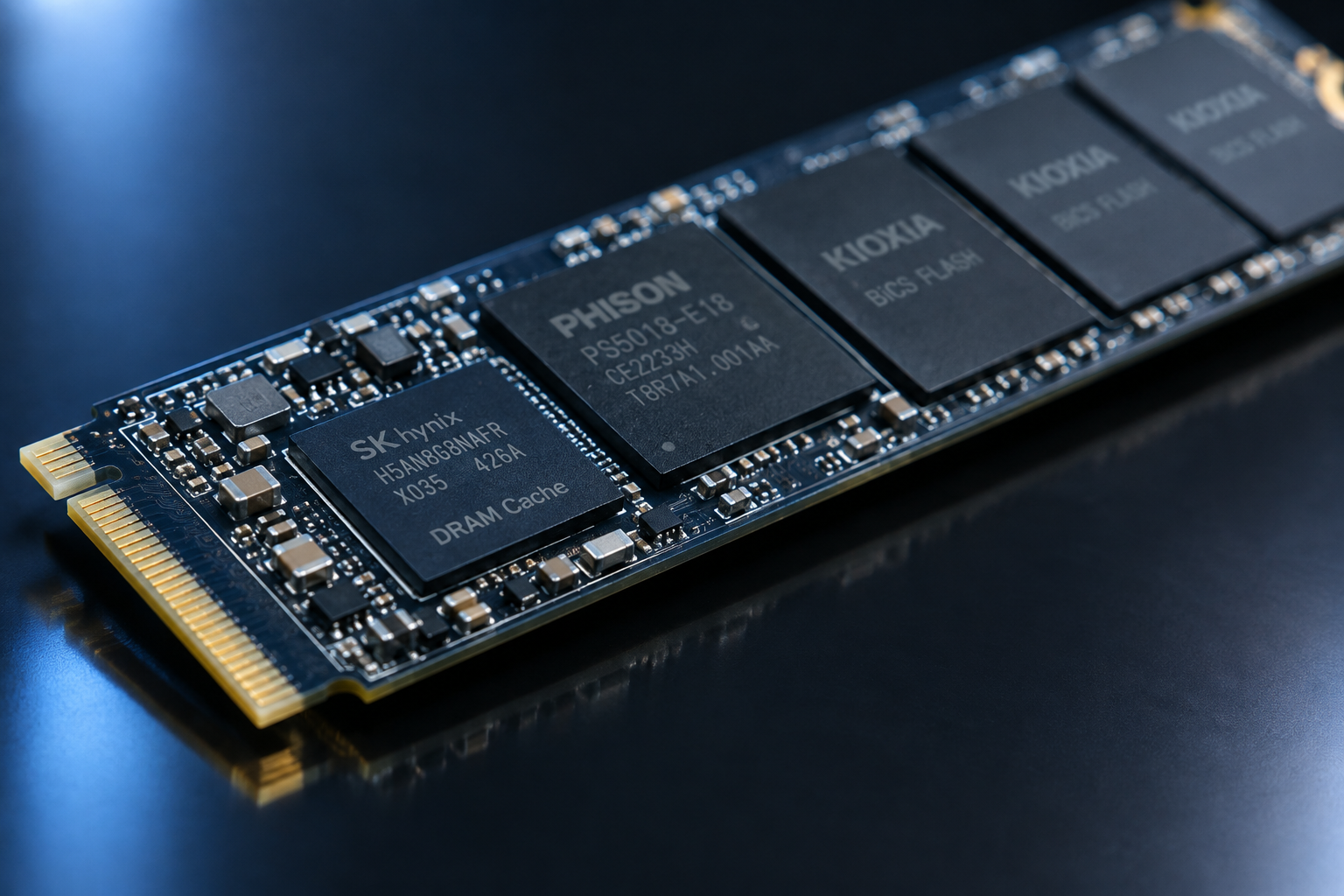
DRAM stores the flash translation layer mapping table so the controller doesn’t have to search through NAND every time it needs to know where data lives. That translates into more consistent performance during large file transfers, database work, and video editing. If you’re trying to understand the bigger picture of why this affects real-world speed, our breakdown on whether NVMe is really faster than SATA SSDs covers the mechanics in more depth.
NVMe SSDs With Confirmed DRAM Cache
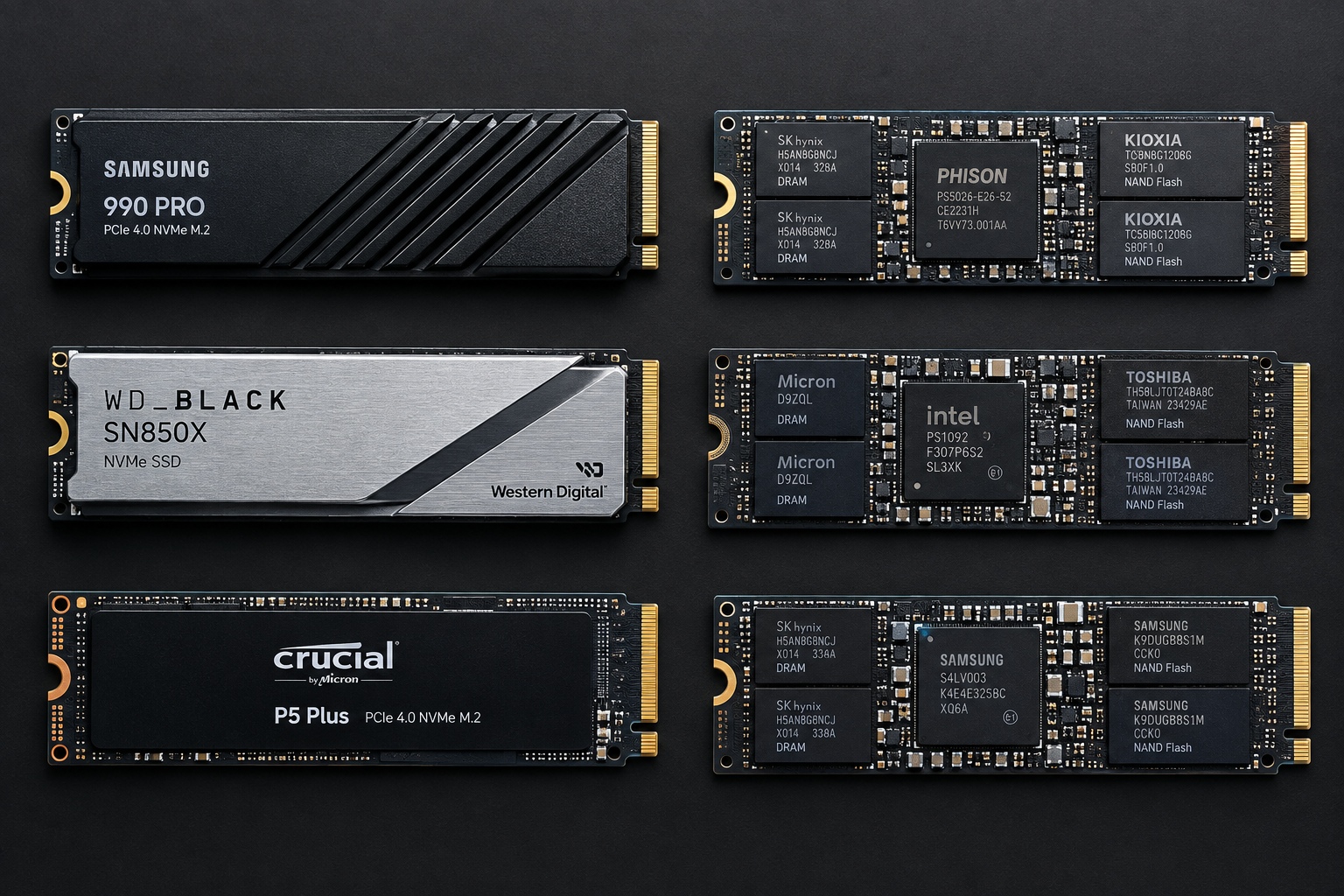
- Samsung 990 PRO: Samsung’s in-house Pascal controller paired with LPDDR4 DRAM and 176L V-NAND TLC. PCIe 4.0. TBW comes in at 600TB for the 1TB model, 1,200TB for 2TB, and 2,400TB for 4TB, all backed by a 5-year warranty.
- Samsung 980 PRO: Elpis controller with DRAM across every capacity, PCIe 4.0. The 250GB and 500GB variants carry noticeably lower TBW (150TB and 300TB) than the 1TB and 2TB models (600TB and 1,200TB), so don’t assume endurance scales evenly.
- WD Black SN850X: WD’s own controller with dedicated DRAM, PCIe 4.0, and BiCS TLC NAND. TBW runs 600TB (1TB), 1,200TB (2TB), and 2,400TB (4TB), with a 5-year warranty across the board.
- Kingston KC3000 / Fury Renegade: Both use the Phison E18 controller with DRAM and Micron 176L TLC, essentially sharing the same platform under different branding. TBW ranges from 800TB at 1TB up to 3,200TB at 4TB, with a 5-year warranty.
- Seagate FireCuda 530: Phison E18 with DRAM, PCIe 4.0, and high endurance ratings, including 2,550TBW on the 4TB model. Seagate backs it with a 5-year warranty and an optional data recovery plan.
- Crucial T700: Phison E26 controller with DRAM, built for PCIe 5.0 speeds. Endurance is rated up to 2,400TBW on the 4TB capacity, with a 5-year warranty.
- Crucial P5 Plus: Micron-controlled, DRAM-equipped, PCIe 4.0 drive with TBW of 600 (1TB) and 1,200 (2TB), 5-year warranty.
Samsung 990 PRO
Consistently one of the fastest DRAM-cache drives available, great for heavy multitasking and large transfers.
If you’re comparing WD’s lineup specifically, our detailed look at the SN770 vs SN850X specs is a good next stop, since the naming convention alone doesn’t tell you which one actually has DRAM.
WD Black SN850X
A strong all-around pick with real DRAM cache and excellent sustained write performance for gaming and content creation.
Watch Out: Drives That Look Like They Have DRAM But Don’t
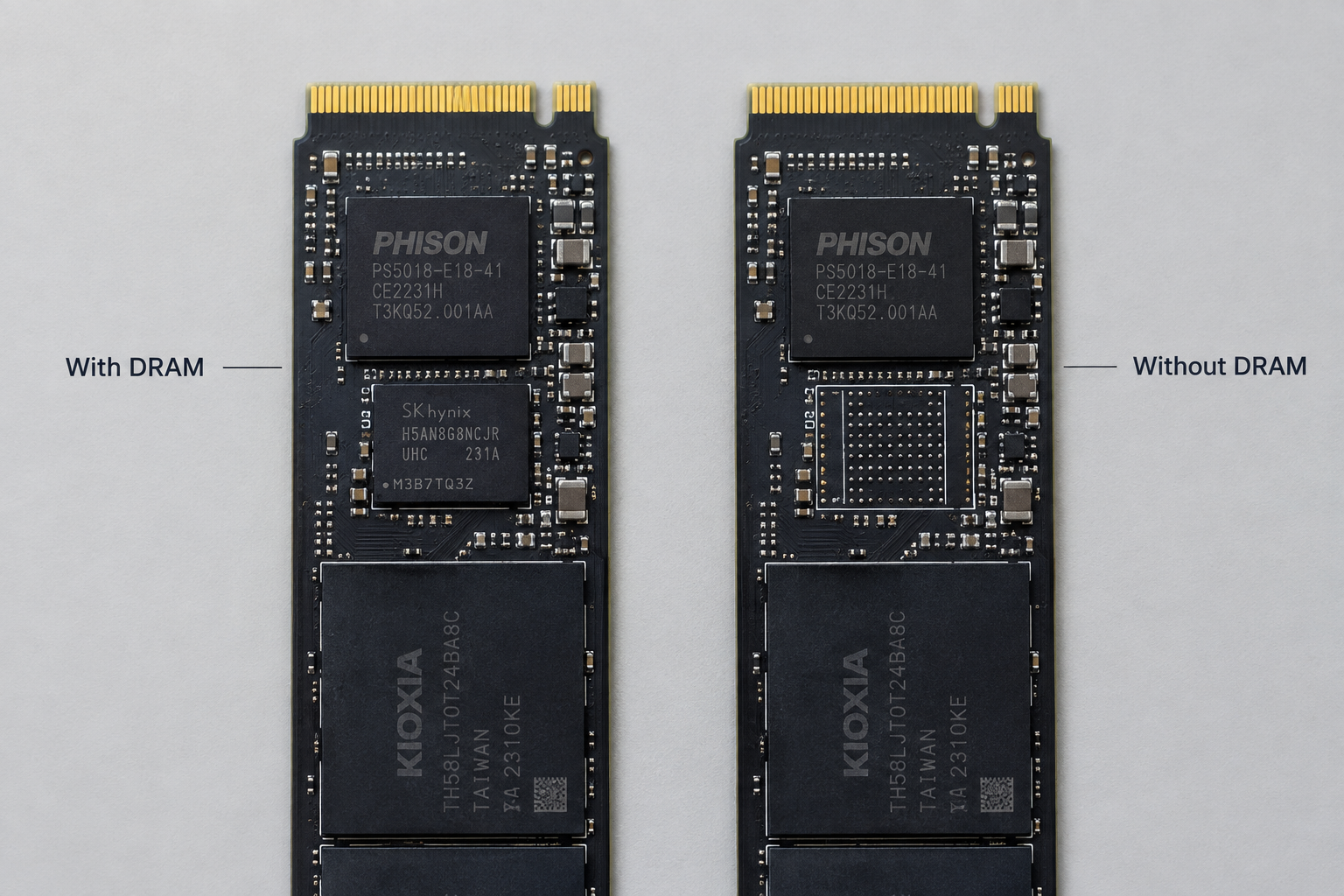
This is where a lot of buyers get tripped up. Several popular “Black” or “Pro” branded drives dropped DRAM entirely and rely on HMB instead.
- WD Black SN770: No onboard DRAM, uses HMB. This is a change from the older SN750, which did include dedicated DRAM.
- Samsung 980 (non-Pro): DRAM-less, HMB-based. Easy to confuse with the 980 PRO, which does have DRAM.
- Samsung 990 EVO: Also DRAM-less, using HMB despite being a newer, faster-sounding model name.
- Crucial P3 and P3 Plus: Both HMB-based with no dedicated DRAM chip.
None of these are bad drives for everyday use, but if you’re doing sustained large writes, video editing, or running a NAS-style workload, the DRAM-equipped models above will hold their performance more consistently. For a broader comparison of how NVMe stacks up against other storage types in gaming rigs, check out SATA vs NVMe SSD for gaming.
Kingston Fury Renegade
Built on the same Phison E18 platform as the KC3000, with high endurance ratings and a full DRAM cache.
If you’re upgrading a laptop or desktop and want to know how much this actually matters day to day, our guide on how important an SSD really is in a laptop puts the DRAM question into practical context.
FAQ
Do I need DRAM cache for gaming?
Not really. Game load times depend more on raw read speed and PCIe generation than DRAM presence. DRAM matters more for sustained writes, large file copies, and workstation-style tasks like editing or virtual machines.
How can I check if a specific SSD has DRAM before buying?
Check the manufacturer’s official spec sheet or a teardown review, since marketing pages don’t always mention it directly. Searching the exact model number alongside “DRAM” or “HMB” usually turns up a clear answer from a reviewer who’s opened the drive or tested it under sustained load.
This article contains affiliate links. We may earn a small commission at no extra cost to you.

James Kennedy is a writer and product researcher at Drives Hero with a background in IT administration and consulting. He has hands-on experience with storage, networking, and system performance, and regularly improves and optimizes his home networking setup.