Best SSDs for Every Budget in 2026
SSD prices keep dropping, and in 2026 there’s genuinely no reason to run your system on a spinning hard drive. Whether you’ve got a tight budget or you’re ready to invest in serious speed, there’s a solid SSD waiting for you. I’ve broken this guide into four price tiers so you can jump straight to the section that matches your wallet.
One important note before we get into picks: prices fluctuate constantly on Amazon, so I’ll link each drive and let you check current pricing rather than quoting numbers that could be outdated by tomorrow. If you’re still deciding between solid-state and traditional drives, our SSD vs HDD comparison covers the fundamentals.
Under competitively priced: Surprisingly Capable Starter Drives
You’d be amazed at what you can get in this price range. These drives won’t break speed records, but they’ll transform an aging laptop or serve as reliable secondary storage.
The Kingston A400 240GB remains the king of budget SATA drives. It’s a 2.5-inch form factor with read speeds up to 500 MB/s, which is roughly 10x faster than a traditional hard drive. Build quality is no-frills, but Kingston’s reliability track record speaks for itself. This is the drive I recommend when someone asks me to speed up their old laptop on the cheap.
Another solid option is the Teamgroup CX2 256GB. It uses 3D NAND flash and delivers consistent SATA III performance. You’ll find it competitive with the Kingston on pricing, and it sometimes edges ahead depending on the day.

Kingston A400 240GB SSD
The best ultra-budget SATA SSD for breathing new life into older laptops and desktops.
At this tier, you’re looking at 240GB to 256GB capacities, which is enough for a Windows or Linux boot drive with room for essential apps. If you need help migrating your existing data, our guide on how to clone your hard drive without losing data walks you through the process step by step.
Under competitively priced: The Sweet Spot for Most People
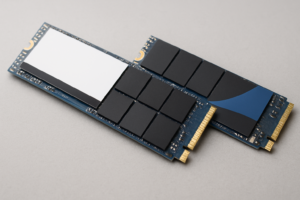
This is where things get interesting. You can grab 500GB SATA drives or entry-level NVMe options in this range, and the performance jump from SATA to NVMe is significant if your motherboard supports it. Not sure which form factor you need? Our M.2 vs 2.5-inch SSD comparison will help you figure that out.
For SATA, the Samsung 870 EVO 500GB is still my top pick. Samsung’s V-NAND technology and in-house controller deliver outstanding consistency, and the 870 EVO has one of the best endurance ratings in its class. It reads at 560 MB/s and writes at 530 MB/s, which maxes out the SATA III interface.
If you want NVMe speed at this budget level, the WD Blue SN580 500GB is an excellent Gen 4 drive that punches above its weight. You’ll see sequential reads around 4,000 MB/s, which is a massive leap over SATA. For everyday computing, boot times, and app launches, you’ll feel the difference immediately.
The Crucial P3 500GB also deserves a mention here. It uses a PCIe Gen 3 interface (so slightly slower than the SN580), but it’s often priced very aggressively and comes backed by Micron’s solid warranty support.

WD Blue SN580 500GB NVMe
A Gen 4 NVMe drive with 4,000 MB/s reads that offers remarkable value for budget-conscious builders.
Under competitively priced: Serious Storage Without Compromise
This tier is where you start getting 1TB NVMe drives, which is the capacity I recommend for most people building or upgrading a primary system. A terabyte gives you room for your OS, a healthy library of games, creative projects, and still leaves breathing room. For help deciding between 1TB and 2TB, check out our capacity comparison guide.
The Samsung 990 EVO 1TB is my top recommendation in this bracket. It supports both PCIe Gen 4 and Gen 5 (x2) interfaces, which means it’s future-proofed for newer motherboards while working perfectly on current systems. Sequential reads hit around 5,000 MB/s, and Samsung’s Magician software gives you excellent drive management tools.
The WD Black SN770 1TB is a strong runner-up. It’s a DRAM-less Gen 4 drive that still manages reads up to 5,150 MB/s thanks to Western Digital’s efficient controller design. Gamers especially appreciate this one for its consistent sustained performance during large game installs and level loads.
For a pure SATA option at this tier, the Samsung 870 EVO 1TB is the obvious choice. SATA speeds are capped at 560 MB/s, but if your laptop only has a 2.5-inch bay (common in older ThinkPads and MacBooks), this is the best drive you can put in it.
Keep in mind that SSDs can lose some speed over time as they fill up. If you’ve noticed your current drive getting sluggish, our article on why your SSD slows down and how to fix it explains exactly what’s happening and how to restore performance.
Under competitively priced: Enthusiast-Grade Performance
At this level, you’re shopping for either high-capacity drives (2TB) or blazing-fast Gen 5 options. This is the territory for content creators, power users, and anyone who refuses to wait for file transfers.
The Samsung 990 Pro 2TB is the drive I keep recommending to friends who do video editing or run virtual machines. It delivers sequential reads up to 7,450 MB/s and writes up to 6,900 MB/s on PCIe Gen 4, with an optional heatsink model for systems that run hot. The endurance rating of 1,200 TBW (terabytes written) means this drive will outlast most of the systems it’s installed in. If you want to know more about its real-world longevity, our SSD lifespan data analysis breaks down the numbers.

Samsung 990 Pro 2TB NVMe
The best all-around enthusiast SSD with exceptional speed, endurance, and 2TB of capacity.
For Gen 5 early adopters, the Crucial T700 1TB pushes sequential reads past 12,000 MB/s. That speed is absurd for consumer hardware, though you’ll need a motherboard with a PCIe 5.0 M.2 slot (common on AMD 600-series and Intel 700-series boards). Thermal management matters at these speeds, so grab the heatsink version if your motherboard doesn’t have its own M.2 shield.
The WD Black SN850X 2TB is another excellent pick that sometimes sneaks into this price tier during sales. It’s a Gen 4 workhorse beloved by gamers and creative professionals alike. If you’re curious how it stacks up against the Samsung, we’ve done a direct comparison between the 990 Pro and SN850X.
Quick Reference: Best SSD by Use Case
- Reviving an old laptop: Kingston A400 240GB (SATA, 2.5-inch)
- General-purpose PC upgrade: WD Blue SN580 500GB (NVMe Gen 4)
- Gaming and everyday power use: Samsung 990 EVO 1TB (NVMe Gen 4/5)
- Content creation and heavy workloads: Samsung 990 Pro 2TB (NVMe Gen 4)
- Maximum speed, no compromises: Crucial T700 1TB (NVMe Gen 5)
If you’re installing an NVMe drive for the first time, our NVMe installation guide covers everything from physically mounting the drive to getting your OS running on it.

James Kennedy is a writer and product researcher at Drives Hero with a background in IT administration and consulting. He has hands-on experience with storage, networking, and system performance, and regularly improves and optimizes his home networking setup.