Best Cheap Portable SSDs That Are Still Reliable
Budget portable SSDs have a dirty little secret: some of them are barely better than a fast USB flash drive. Manufacturers cut corners on controllers, NAND quality, and thermal management to hit low price points, and you end up with a drive that crawls after transferring a few gigabytes or dies within a year. I’ve seen it happen more times than I’d like.
But there are genuine bargains out there if you know what to look for. A handful of portable SSDs manage to stay affordable while still using quality components, offering decent speeds, and lasting more than a couple of years. This roundup separates the reliable budget picks from the ones you should avoid entirely.
What Makes a Cheap Portable SSD “Reliable”?
Before jumping into specific models, it helps to understand what separates a cheap-but-good SSD from a cheap-and-terrible one. Three things matter most at this price range: the NAND type, the controller, and the warranty.
NAND flash: You want TLC (triple-level cell) NAND at minimum. Some ultra-budget drives use QLC, which wears out faster and slows down significantly when the SLC cache fills up. If you’ve ever noticed your SSD slowing down dramatically over time, QLC NAND is often the culprit in portable drives too.
Controller: Brand-name controllers from companies like Phison, Silicon Motion, or Realtek handle error correction and wear leveling properly. No-name controllers found in some Amazon-special drives can lead to data corruption and early failure.
Warranty: Any reputable manufacturer backs their portable SSD with at least a 3-year warranty. If a drive only carries a 1-year warranty, the manufacturer isn’t confident in its own product. Take that as a red flag.
Top Budget Portable SSDs Worth Buying
Samsung T7 Shield (1TB)
The Samsung T7 Shield is the gold standard for affordable portable SSDs. Samsung makes its own NAND and controllers, which means tight quality control from top to bottom. You get up to 1,050 MB/s reads over USB 3.2 Gen 2, IP65 dust and water resistance, and a rubber outer shell that can handle a 3-meter drop.
The T7 Shield uses TLC NAND with a generous SLC cache, so sustained write speeds hold up well even during large file transfers. Samsung also includes optional password-based AES 256-bit hardware encryption through its Portable SSD software. With a 3-year warranty and Samsung’s track record, this is the safest bet in the budget category.
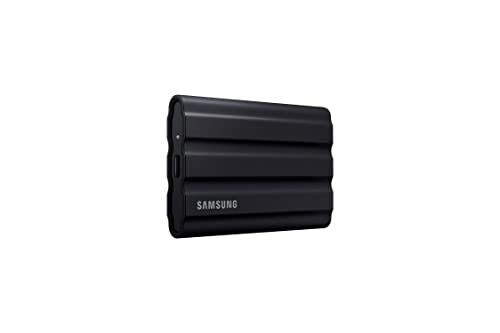
Samsung T7 Shield 1TB Portable SSD
Best overall budget pick with IP65 durability, fast speeds, and Samsung’s own NAND and controller.
Crucial X9 (1TB)
Crucial (owned by Micron, one of the world’s largest NAND manufacturers) released the Crucial X9 as a no-frills competitor to Samsung’s lineup. It delivers up to 1,050 MB/s sequential reads, weighs just 35 grams, and comes with a clean, minimalist aluminum design. There’s no hardware encryption or IP65 rating here, but the internals are solid.
What makes the X9 stand out is consistency. Micron manufactures its own NAND, and the X9 uses 176-layer TLC with a Phison controller. Sustained write performance is respectable, and the drive runs cool even during extended transfers. If you don’t need rugged protection and just want a fast, reliable, compact drive, this one deserves a serious look.
SanDisk Extreme (1TB)
The SanDisk Extreme Portable SSD has been a popular choice for years, and the latest revision offers up to 1,050 MB/s reads with IP55 water and dust resistance. The carabiner loop is a small touch that makes it genuinely practical for attaching to a bag or keychain. If you travel frequently, we’ve covered this model in more depth in our roundup of the best portable SSDs for travel.
One caveat: earlier firmware versions of the SanDisk Extreme had well-documented overheating and disconnection issues. Western Digital (SanDisk’s parent company) has since released firmware updates that largely resolved this. Make sure you update the firmware immediately after purchase using the SanDisk Dashboard software.
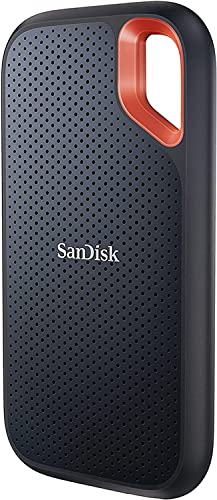
SanDisk Extreme 1TB Portable SSD
Great travel companion with IP55 rating and carabiner loop, just update the firmware right away.
Kingston XS1000 (1TB)
Kingston doesn’t get the marketing buzz that Samsung or SanDisk enjoy, but the Kingston XS1000 is a quietly excellent budget option. It’s tiny (smaller than a stick of gum), offers up to 1,050 MB/s reads, and comes with a 5-year warranty, which is the longest on this list.
The tradeoff is that it has no IP rating and no encryption software. It’s essentially a fast NVMe drive in a minimal USB enclosure. For simple backup duties or shuttling files between machines, it’s hard to beat at its price point. Just don’t drop it in a puddle.
WD Elements SE SSD (1TB)
The WD Elements SE SSD is often the cheapest name-brand portable SSD you’ll find. It maxes out at 400 MB/s, which is noticeably slower than the other drives on this list. But if your use case involves basic file storage, backups, or media playback, 400 MB/s is still dramatically faster than any portable hard drive.
Think of this as the option for people who are stepping up from a traditional HDD and want SSD reliability without paying for speed they don’t need. It’s backed by WD’s 3-year warranty and uses known components under the hood.
Drives to Avoid at This Price Range
A few categories of portable SSDs consistently disappoint at the budget level. Avoid these patterns:
- Unbranded Amazon drives with too-good-to-be-true specs. If a brand you’ve never heard of claims 2,000 MB/s and 4TB for a suspiciously low price, it’s almost certainly a scam. Many of these are actually USB flash drives with faked capacity readouts.
- Older drives with SATA bridges. Some budget portable SSDs use a SATA SSD internally connected through a USB-to-SATA bridge. This caps real-world speeds around 400-500 MB/s, but some manufacturers still advertise higher theoretical numbers.
- Drives with only a 1-year warranty. This is the biggest red flag. Reputable SSD manufacturers offer 3 to 5 years because their drives are engineered to last that long. A short warranty signals cheap internals.
If you do end up replacing an old drive with a new one, don’t forget to securely wipe your old drive before selling or recycling it. Portable SSDs store a lot of personal data, and a simple format isn’t enough to remove it completely.
My Top Pick
If I had to buy one budget portable SSD today, I’d go with the Samsung T7 Shield 1TB. The combination of speed, durability, encryption, and Samsung’s vertical integration (they make the NAND, controller, and firmware in-house) gives it an edge over everything else at this price. The Crucial X9 is a close second if you prefer a slimmer, lighter form factor and don’t need the ruggedized shell.
For anyone on a tighter budget who doesn’t need top-end speeds, the WD Elements SE SSD gets the job done without any drama. It won’t win any benchmarks, but it won’t lose your data either. You might also want to check out our best budget SSDs under competitively priced roundup for internal drives if you’re upgrading a desktop or laptop at the same time.
Frequently Asked Questions
How long do cheap portable SSDs typically last?
Most name-brand portable SSDs are rated for a TBW (terabytes written) that far exceeds typical consumer use. A 1TB drive from Samsung, Crucial, or WD will typically handle 300-600 TBW before the NAND wears out. For perspective, if you write 50GB per day every single day, a 300 TBW drive would last over 16 years. Real-world lifespan is more often determined by physical damage or controller failure than NAND wear. For a deeper look at SSD longevity, check out our analysis of how long SSDs really last.
Can I use a budget portable SSD as my primary backup drive?
Absolutely, but follow the 3-2-1 backup rule: keep three copies of your data, on two different types of media, with one stored offsite. A portable SSD works great as one leg of that strategy. Pair it with a cloud backup or a NAS for proper redundancy. Relying on a single drive of any kind, no matter how reliable, is a risk you don’t want to take.
Do I need USB 3.2 Gen 2 to get full speed from these drives?
Yes. USB 3.2 Gen 2 (10 Gbps) is required to reach the 1,000+ MB/s speeds that most of these drives advertise. If your computer only has USB 3.0 (5 Gbps) ports, you’ll be limited to roughly 400-450 MB/s in practice. The drives will still work perfectly fine on older USB ports, just at reduced speeds. Check your laptop or desktop specs before buying, and if your external drive keeps disconnecting, the USB port or cable is usually the problem, not the SSD itself.
This article contains affiliate links. We may earn a small commission at no extra cost to you.

James Kennedy is a writer and product researcher at Drives Hero with a background in IT administration and consulting. He has hands-on experience with storage, networking, and system performance, and regularly improves and optimizes his home networking setup.