M 2 Ssd Vs Ssd Speed: Which Option Is The More Favorable?
M.2 SSDs often offer higher speeds compared to traditional SATA SSDs. Utilizing NVMe interface technology, M.2 drives can provide read/write speeds that exceed 2000 MB/s, significantly faster than SATA SSDs which typically max out around 550-600 MB/s.
Check out this helpful video on the topic:
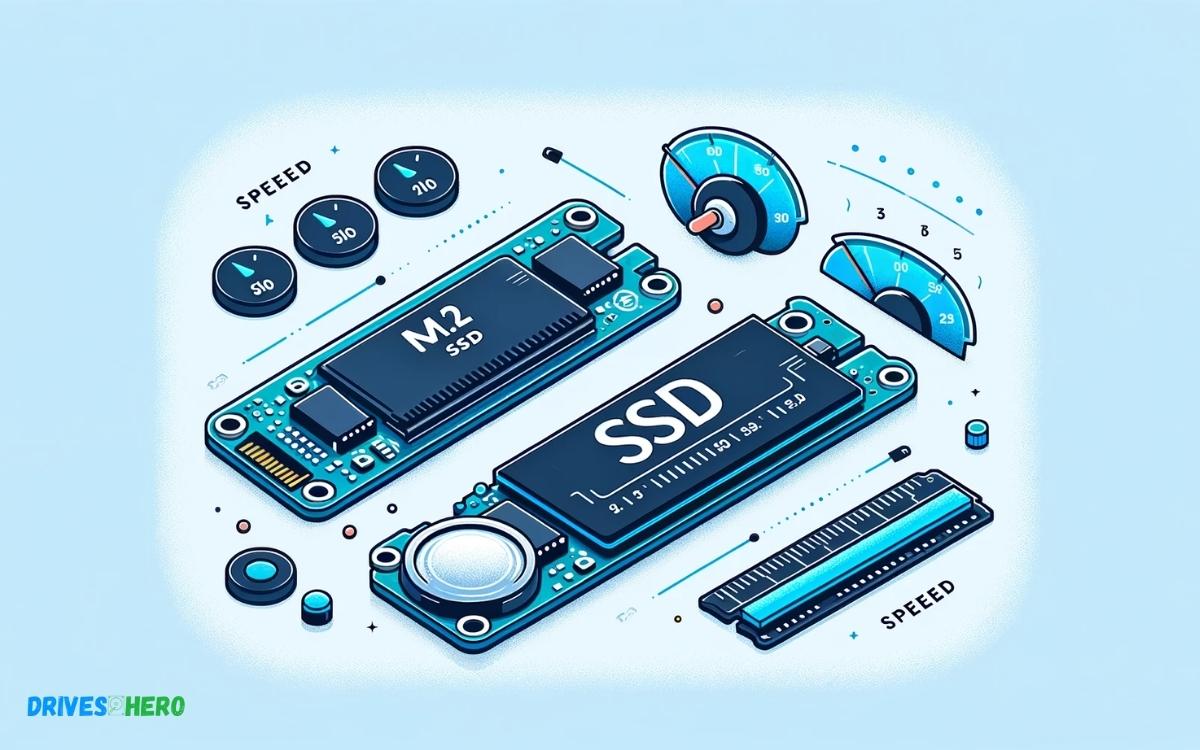
The key difference between M.2 SSDs and standard SSDs lies in the form factor and interface:
For instance, while a SATA SSD may deliver read speeds of up to 550 MB/s, an M.2 NVMe SSD can offer read speeds of up to 3500 MB/s or more, depending on the specific model and generation of PCIe used.
When it comes to raw data transfer rates, M.2 NVMe SSDs outpace their SATA counterparts, making them the preferred choice for high-performance computing tasks.
Key Takeaway
8 Features Of M 2 Ssd Vs Ssd Speed
| Feature | M.2 SSD | SATA SSD |
|---|---|---|
| Interface | M.2 (capable of running NVMe or SATA) | SATA III |
| Max Throughput | Up to 32 Gb/s (NVMe using PCIe 3.0 x4) | Up to 6 Gb/s |
| Average Read Speed | 1,000 to 3,500 MB/s (NVMe) | 500 to 550 MB/s |
| Average Write Speed | 1,000 to 3,000 MB/s (NVMe) | 500 to 500 MB/s |
| Form Factor | 22mm wide, lengths of 30, 42, 60, 80, or 110mm | 2.5 inches or 3.5 inches |
| Boot Time | Generally faster boot times due to higher speeds | Slower boot times compared to M.2 NVMe SSDs |
| Power Consumption | Generally lower because of better efficiency | Generally higher due to older technology |
| Price | Often more expensive due to higher performance | Usually more affordable |
Understanding M.2 Ssds And Ssds
In the world of storage devices, M.2 SSDs and SSDs are two popular options known for their speed and efficiency.
Understanding the differences and benefits of these storage solutions can help users make informed decisions based on their specific needs.
Definition Of M.2 Ssd
M.2 SSDs, also known as Next Generation Form Factor (NGFF) SSDs, are a compact and versatile form of solid-state drives that are designed to be compatible with smaller devices such as ultrabooks, tablets, and hybrid devices.
They use the M.2 form factor, which allows for a more efficient use of space and faster data transfer rates compared to traditional 2.5-inch SATA SSDs.
Definition Of Ssd
- SSDs, or solid-state drives, are storage devices that store data using semiconductor-based memory.
- Unlike traditional hard disk drives (HDDs), SSDs do not have any moving parts, resulting in faster read and write speeds, lower power consumption, and increased durability.
- They are commonly used to upgrade the storage capacity and performance of desktops, laptops, and servers.
Difference In Physical Structure
The physical structure of M.2 SSDs differs from that of traditional SSDs. M.2 SSDs are designed with a smaller form factor and connect to the motherboard via an M.2 slot, which supports high-speed PCIe and SATA interfaces.
- Traditional SSDs, on the other hand, are typically larger and connect via SATA cables or other compatible interfaces.
- This variation in structure allows M.2 SSDs to offer greater flexibility for compact and efficient storage solutions.
The Evolution Of Ssd Technology
SSD technology has evolved rapidly, with advancements in NAND flash memory and controller designs leading to improved performance, reliability, and affordability.
The introduction of M.2 SSDs represents a significant development in the evolution of SSD technology, providing a solution that prioritizes speed, efficiency, and form factor versatility.
As the demand for faster and more reliable storage continues to grow, SSD technology continues to push the boundaries of innovation and capability.
M.2 Ssd Speed Vs. Ssd Speed: Technical Specifications
When choosing between an M.2 SSD and a traditional SSD, considering the technical specifications and performance is crucial. Understanding the differences in speed and the factors influencing it can help in making an informed decision.
Read And Write Speeds Comparison
- M.2 SSDs are known for their superior read and write speeds when compared to conventional SSDs.
- The M.2 SSDs leverage the NVMe or PCIe interface, enabling them to achieve sequential read speeds of up to 3500MB/s and write speeds of up to 3000MB/s.
- On the other hand, a standard SATA SSD typically offers sequential read speeds of around 550MB/s and write speeds of around 520MB/s.
Impact Of Interfaces (sata, Nvme, Pcie) On Speed
The interface plays a pivotal role in determining the speed of an M.2 SSD or SSD. The SATA interface, commonly used in traditional SSDs, imposes limitations due to its bandwidth.
On the contrary, NVMe and PCIe interfaces, utilized by M.2 SSDs, provide significantly higher bandwidth, resulting in improved data transfer rates and reduced latency, thus elevating the overall speed and performance.
Factors Influencing Speed Performance
- The type of interface (SATA, NVMe, PCIe) directly impacts the speed of the storage device.
- The quality and type of NAND flash memory used in the SSD affect its performance.
- The controller chip and the number of channels present on the SSD contribute to the overall speed.
- The workload and usage scenarios also influence the actual speed experienced in real-world usage.
Benchmarking Tests And Results
To gain a comprehensive understanding of the speed differences between M.2 SSDs and SSDs, numerous benchmarking tests have been conducted.
The results consistently demonstrate the superiority of M.2 SSDs in terms of speed, especially when handling large files and intensive workloads.
Real-world Performance Differences
When comparing M.2 SSDs and SATA SSDs, it’s important to consider the real-world performance differences to understand which is more suitable for your specific needs.
From boot times to content creation, the speed and responsiveness of your storage drive can have a significant impact on your computing experience.
Boot Time And System Responsiveness
- The M.2 SSDs outperform SATA SSDs when it comes to boot time and system responsiveness.
- With quicker read and write speeds, M.2 SSDs significantly reduce the time it takes for your system to start up and for applications to load.
- This translates to a smoother and more responsive computing experience, with minimal lag or delay.
Loading Times Of Applications And Games
M.2 SSDs excel in reducing loading times for both applications and games, thanks to their faster data transfer rates.
Whether you’re launching software or immersing yourself in the latest gaming titles, M.2 SSDs offer a noticeable improvement in loading speeds, allowing for a seamless and uninterrupted experience.
Impact On Productivity Tasks
When it comes to productivity tasks such as file transfers, M.2 SSDs showcase notable speed advantages over SATA SSDs. This translates to faster file access and enhanced multitasking capabilities, ultimately boosting productivity and efficiency.
Multimedia And Content Creation Performance
Content creators and multimedia enthusiasts can benefit from the superior performance of M.2 SSDs, particularly when working with large files and high-resolution media.
With their rapid data transfer rates, M.2 SSDs enable smoother editing workflows and quicker rendering times, contributing to a more seamless and efficient content creation process.
Advantages And Disadvantages Of M.2 Ssd And Ssd Speed
When it comes to choosing between M.2 SSD and traditional SSD, it’s important to understand the advantages and disadvantages of their speed capabilities. Both M.2 SSD and SSD have their unique qualities that make them suitable for different purposes.
M.2 Ssd Speed Advantages
M.2 SSDs have several advantages when it comes to speed. They offer faster read and write speeds compared to traditional SSDs, resulting in quicker boot times and improved overall system performance.
With higher data transfer rates, M.2 SSDs excel in handling large files and demanding applications, making them ideal for gaming, video editing, and other resource-intensive tasks.
Ssd Speed Advantages
Traditional SSDs also boast impressive speed advantages. They provide significantly faster data access compared to mechanical hard drives, leading to faster loading times for applications and improved system responsiveness.
SSDs are well-suited for everyday computing tasks, such as web browsing, document processing, and multimedia playback.
Limitations Of M.2 Ssd Speed
Despite their high speed, M.2 SSDs may face limitations in compatibility with older systems that do not support the M.2 form factor.
M.2 SSDs can heat up quickly under heavy workloads, affecting their performance over time. It’s crucial to ensure proper cooling measures are in place to mitigate these limitations.
Limitations Of Ssd Speed
While traditional SSDs offer impressive speed, they may still fall short in terms of write endurance and limited lifespan compared to M.2 SSDs.
Their performance may degrade over time, especially when the drive nears its capacity. It’s important to consider these limitations when choosing an SSD for long-term usage.
Future Outlook: The Evolution Of Ssd Technology
Discover how the M. 2 SSD outperforms traditional SSDs in speed and performance. Learn about the evolution of this technology and its future outlook as it continues to redefine storage solutions for personal and professional use.
Technological Advancements In M.2 Ssds
M.2 SSDs have rapidly advanced in recent years, primarily driven by the transition to the NVMe protocol, which allows for faster and more efficient data transfer.
The introduction of PCIe 4.0 and PCIe 5.0 interfaces has led to significant improvements in M.2 SSD speed.
These advancements have enabled M.2 SSDs to offer impressive read and write speeds, making them a favorable choice for both consumer and enterprise applications.
Technological Advancements In Ssds
Traditional SSDs have also seen considerable advancements in technology, particularly with the integration of 3D NAND flash storage and the adoption of SATA III and NVMe interfaces, resulting in substantial speed and performance enhancements.
These improvements have contributed to the widespread adoption of SSDs across various industries.
Predictions For Future Speed Improvements
Future advancements in SSD technology are expected to continue at a rapid pace, with projections indicating even faster NVMe speeds, potentially reaching beyond the current limitations.
Innovations in storage architecture and flash memory technology are likely to drive these speed improvements, offering enhanced data access and transfer rates for users across different sectors.
Implications For Consumer And Enterprise Use
The evolution of SSD technology is poised to have wide-ranging implications for both consumer and enterprise use.
As SSD speed continues to advance, consumers can expect improved system responsiveness, faster application loading times, and seamless multitasking.
For enterprises, these speed improvements can lead to enhanced data processing, reduced latency, and increased productivity in demanding workloads such as data analytics and high-performance computing.
Conclusion
M. 2 SSD and SSD speed differences lie in their form factor and performance. M. 2 SSD offers faster data transfer rates and compact size, while SSDs provide reliable and cost-effective storage solutions.
Understanding their variations will help you make an informed decision based on your specific needs. Explore further to make the right choice for your system.

Harold Williams is a senior writer and technical editor at Drives Hero with 20+ years of experience in IT administration. He specializes in storage systems, SSD reviews, and performance testing, bringing real-world insight to every guide.