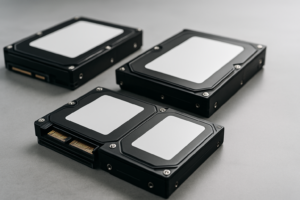
WD Blue vs Seagate Barracuda: Best Budget Desktop Hard Drive
If you’re shopping for a budget desktop hard drive, you’ve probably narrowed it down to two names: the WD Blue and the Seagate Barracuda. These two have been going head-to-head for over a decade, and both remain the default picks for general desktop storage, bulk file archives, and secondary drives. But they’re not identical, and depending on your priorities, one is a better fit than the other.
I’ve used both extensively in desktop builds, NAS boxes, and as backup drives. Here’s how they actually compare where it matters: reliability, speed, noise, and price.
Speed: Barracuda Takes the Lead
The Seagate Barracuda (ST2000DM008, ST4000DM004, etc.) spins at 7200 RPM across most of its lineup. The WD Blue, on the other hand, uses 5400 RPM platters for its 1TB and larger models. That RPM difference is real. In sequential read/write benchmarks, the Barracuda typically delivers 180-210 MB/s compared to the WD Blue’s 130-170 MB/s.
For everyday desktop use, you’ll notice the difference when copying large folders, loading applications from the HDD, or scrubbing through video files. If speed is a priority and you’re not ready to move to an SSD (here’s our full breakdown of SSD vs HDD and when each makes sense), the Barracuda wins this round clearly.
One popular approach is pairing an SSD boot drive with an HDD for mass storage. In that setup, the HDD’s raw speed matters less, and both drives perform well as secondary storage.

Seagate Barracuda 2TB Internal Hard Drive
Faster 7200 RPM speed and strong sequential performance make this the better pick for general desktop use.
Reliability: A Close Call With an Edge to WD Blue
Both drives carry a 2-year limited warranty. Backblaze’s annual drive stats (the largest public dataset on drive failure rates) have shown both families performing reasonably well, though results vary by capacity and model year. In general, WD Blue drives have posted slightly lower annualized failure rates in the 1-2% range, while certain Barracuda models (especially older SMR-based variants) have occasionally crept higher.
The WD Blue’s slower spindle speed also means less mechanical stress and lower operating temperatures. Over a 3-5 year lifespan, that can add up. If you’re building a system for someone who won’t think about backups (though they should), the WD Blue’s track record gives it a small but meaningful edge.
If you hear any unusual sounds from either drive down the road, check our guide on what hard drive clicking sounds mean and what to do about them before it’s too late.

WD Blue 2TB Desktop Hard Drive
Slightly better long-term reliability and quieter operation for budget desktop builds and backup drives.
Noise and Vibration
This one is simple. The WD Blue runs noticeably quieter. At 5400 RPM, it produces less vibration and a softer hum. The Barracuda at 7200 RPM isn’t loud by any means, but in a quiet office or bedroom PC, you can hear the difference. If your case sits on your desk near your ears, the WD Blue is the more comfortable daily companion.
Price and Value
Pricing between these two stays competitive and fluctuates frequently. At the 1TB and 2TB capacities, they’re often within a couple of dollars of each other. The Barracuda lineup extends up to 8TB in the standard desktop range, while the WD Blue tops out at 6TB (you’d need to jump to WD Red or WD Purple for higher capacities). Check current pricing on Amazon for both, as deals shift regularly.
For anyone building a budget NAS, keep in mind that neither of these is designed for 24/7 multi-bay operation. You’d want NAS-rated drives for that. Our budget home NAS build guide covers the right drive choices for that scenario.
The Verdict
Pick the Seagate Barracuda if you want the fastest budget HDD for a desktop and don’t mind a touch more noise. It’s the better performer for file transfers, game installs on a secondary drive, and general responsiveness.
Pick the WD Blue if you prioritize quiet operation, slightly lower power draw, and a modest reliability advantage. It’s an excellent choice for backup drives, media storage, and builds where the HDD runs in the background.
If I had to pick just one for a typical desktop build in 2026, I’d lean toward the Seagate Barracuda. The speed advantage is tangible, and the reliability gap is small enough that regular backups (which you should be doing regardless) close the difference entirely.
Frequently Asked Questions
Are WD Blue and Seagate Barracuda drives good for gaming?
They work fine for storing games, but load times will be significantly slower compared to even a basic SATA SSD. If you’re using one as a secondary drive alongside an SSD boot drive, the Barracuda’s 7200 RPM speed will load games a bit faster than the WD Blue’s 5400 RPM. For the best gaming experience, consider an SSD for your most-played titles and use either HDD for your backlog.
Do these drives use SMR or CMR recording technology?
This is an important detail. Several models in both lineups use Shingled Magnetic Recording (SMR), which can slow down significantly during sustained writes. The Seagate Barracuda 2TB (ST2000DM008) uses SMR, while the 4TB and 8TB models use CMR. For WD Blue, the 1TB and 2TB models are typically SMR, with larger capacities using CMR. If you plan to use the drive in a NAS or for heavy sustained writes, prioritize a CMR model. When upgrading your old drive, remember to securely wipe it before selling or disposing of it.
This article contains affiliate links. We may earn a small commission at no extra cost to you.

James Kennedy is a writer and product researcher at Drives Hero with a background in IT administration and consulting. He has hands-on experience with storage, networking, and system performance, and regularly improves and optimizes his home networking setup.