SSD Health Dropped 1%: Should You Worry?
You glance at your SSD monitoring software and notice the health percentage ticked down from 100% to 99%, or maybe from 95% to 94%. Your first instinct is probably to assume the drive is dying. Before you start panic-buying a replacement or backing up every file on your system at 2am, it helps to understand what that number is actually measuring and why small drops are usually nothing to worry about.
What That Health Percentage Actually Means

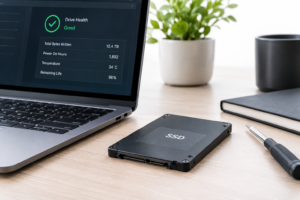
SSD health percentages are not a direct measurement of “how close to death” your drive is. They’re a calculated estimate, usually derived from one or two SMART or NVMe attributes, most commonly wear leveling count or percentage used.
Every NAND flash cell can handle a limited number of program/erase cycles before it starts to degrade. Manufacturers set a rated endurance for each drive, expressed in TBW (terabytes written) or DWPD (drive writes per day). The health percentage is essentially a rough ratio of how much of that rated endurance you’ve consumed.
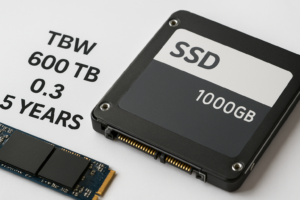
So when your tool shows 99% health, it typically means you’ve used up about 1% of the drive’s estimated write endurance, not that the drive is 1% closer to imminent failure. A 1TB drive rated for 600TBW that shows 99% health has probably had somewhere around 6TB of total writes over its lifetime. That’s nothing.
Which SMART/NVMe Fields Actually Matter

Not every attribute in a SMART report deserves your attention. If you want a realistic picture of drive health, focus on these:
- Percentage Used (NVMe attribute 0xA6, “Percentage Used”): This is the closest thing to an industry-standard wear indicator on NVMe drives. It’s normalized against the manufacturer’s endurance rating, and 100% doesn’t mean the drive stops working, it means it’s reached its rated write limit.
- Media and Data Integrity Errors: Any nonzero value here is worth investigating. This tracks actual uncorrectable errors during reads or writes.
- Reallocated Sector Count (SATA SSDs): A rising count means the drive is retiring bad blocks. Occasional small increases are normal early in life, but a fast-climbing number is a red flag.
- Available Spare (NVMe): This reflects how much reserved spare capacity remains for replacing worn-out blocks. Once this drops below the threshold (often 10%), most drives will throw a warning.
- Power-On Hours and Power Cycle Count: Not warning signs by themselves, but useful context for interpreting other numbers.
- Critical Warning flag (NVMe): If this is nonzero, pay attention immediately. It flags conditions like temperature exceeding thresholds, spare capacity running low, or the drive being in a read-only state.
A single percentage buried in a monitoring app summary is a convenience number. The fields above are where the real diagnostic information lives.
When a Drop Is Completely Normal
Health percentages don’t decrease in a straight line, and they definitely don’t decrease at a rate you should extrapolate linearly. A 1% drop after installing a big game library, running a major OS update, or finishing a large video export is expected. You just wrote a meaningful chunk of data, and the wear leveling counter moved accordingly.
It’s also worth remembering that these percentages often update in coarse steps. Some tools only recalculate the figure after a certain amount of data has been written, so you might see it sit at 100% for months, then drop 1 or 2 points at once. That’s a reporting artifact, not a sudden health event.
If you just upgraded to a new drive or recently did a large data migration, like moving files onto a bigger SSD, a modest early dip is genuinely nothing to worry about. If you’re weighing a capacity upgrade in general, this guide on how to upgrade to a larger SSD covers the process without any of the wear-related anxiety.
Manufacturer-Specific Health Calculations
Here’s where a lot of confusion comes from: not every brand calculates “health” the same way, and comparing percentages across tools or drives from different manufacturers is misleading.
- Samsung Magician: Calculates health mostly from Total Bytes Written relative to the drive’s rated TBW, with some weighting from other SMART attributes. It tends to be conservative, meaning the percentage can look lower than actual remaining life would suggest.
- WD Dashboard / SSD Dashboard: Uses a similar TBW-based estimate but factors in NAND wear leveling counters more heavily, which is why a WD Black SN770 and an SN850X can show different health trajectories under identical workloads. If you’re comparing those two directly, the WD Black SN770 vs SN850X specs breakdown explains the endurance ratings side by side.
- CrystalDiskInfo: Often just reports the raw manufacturer-provided health attribute without much additional interpretation, so its accuracy depends entirely on how honest the drive’s firmware is about that number.
- Intel/Solidigm tools: Historically used a “Media Wearout Indicator” that counted down from 100, similar in spirit to Samsung’s approach but with different thresholds for triggering warnings.
Because of these differences, a 94% health reading on one brand’s software isn’t necessarily equivalent to 94% on another. If you’re choosing between platforms, our comparison of NVMe SSD vs Intel SSD touches on how endurance and reporting differ across controller types.
Warning Signs That Actually Justify Action

A drop from 100% to 99% is background noise. What you actually want to watch for is a pattern, not a single number. Consider backing up immediately and planning a replacement if you see any of the following:
- Health percentage dropping several points in a short period without a corresponding spike in your own write activity.
- Reallocated or pending sector counts climbing steadily over consecutive checks.
- Any nonzero value in Media Errors or Uncorrectable Error counts.
- The drive throwing SMART failure warnings at boot, even if the OS still loads normally.
- Noticeably slower read/write speeds compared to when the drive was new, especially combined with a wear indicator above 90% used.
- File corruption, unexplained crashes, or apps failing to launch that previously worked fine.
If you’re seeing two or more of these together, don’t wait for the health percentage to “confirm” it. Back up your data that day, and start shopping for a replacement. Waiting for an SSD to fully die often means losing whatever wasn’t backed up in the interim.
A single low health percentage is a data point. A combination of rising errors, slowing performance, and unusual behavior is a pattern, and patterns are what actually predict failure.
What To Do If You’re Genuinely Concerned
Run a full SMART scan with a tool matched to your drive’s brand rather than relying on generic utilities, since manufacturer software tends to expose more granular attributes. Cross-check the Percentage Used or wear leveling count against your drive’s rated TBW, which you can usually find on the manufacturer’s spec sheet or in reviews.
If the numbers genuinely look concerning, or the drive is old enough that you’re due for an upgrade anyway, this is a good moment to think about your setup rather than just swapping in an identical replacement. If you’re still running a mechanical hard drive alongside your SSD, it’s also worth revisiting the benefits of upgrading HDD to SSD for anything you haven’t migrated yet.
And if you’re not sure whether your laptop even supports an internal swap, check our guides for specific models, like the ones covering Dell XPS 13 SSD upgrades or MacBook Pro 2020 SSD upgrades, before assuming you need external storage instead.
Frequently Asked Questions
Does a 1% health drop mean my SSD is failing?
No. A 1% drop almost always reflects normal write accumulation relative to the drive’s rated endurance, not physical failure. SSDs are designed to handle hundreds of terabytes of writes before endurance becomes a real concern, so losing 1% of that headroom is expected over normal use.
What SSD health percentage should worry me?
There’s no universal cutoff, but once Percentage Used climbs above 90 percent, or Available Spare drops below the manufacturer’s warning threshold, it’s time to start monitoring more closely and make sure backups are current. Combine that number with actual error counts before deciding it’s a serious problem.
Can I trust the health percentage shown by third-party tools like CrystalDiskInfo?
Mostly, but with a caveat: these tools usually just relay the raw value reported by the drive’s firmware, so the accuracy depends on the manufacturer’s own calculation. Cross-referencing with the brand’s official software gives you a more reliable picture, especially for less common controllers.

James Kennedy is a writer and product researcher at Drives Hero with a background in IT administration and consulting. He has hands-on experience with storage, networking, and system performance, and regularly improves and optimizes his home networking setup.