CrystalDiskInfo Says Bad: What Should You Do?
You installed CrystalDiskInfo, glanced at the health status, and now you’re staring at a yellow “Caution” or a red “Bad” label wondering if your drive is about to die on you. Before you panic and start shopping for a replacement, it helps to actually understand what that status is telling you, because it’s not always as dire as the color suggests.
CrystalDiskInfo is reading raw SMART and NVMe data straight from your drive’s firmware, but the interpretation of that data varies wildly between manufacturers. A “Bad” reading on a Samsung drive doesn’t always mean the same thing as a “Bad” reading on a Crucial or WD drive. Let’s break down what’s actually happening under the hood.
What the Health Percentage Actually Represents

That single health number you see, the one that drops from 100% down toward 0%, is not a scientific prediction of remaining drive life. It’s a calculated value based on specific attributes the manufacturer decided to expose, and every brand weighs those differently.
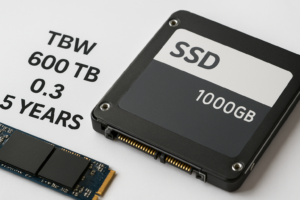
On most NVMe SSDs, the number is tied closely to the “Percentage Used” attribute. This is the drive’s firmware estimating how much of its rated write endurance you’ve consumed, based on total bytes written compared to the manufacturer’s endurance rating (usually expressed in TBW, or terabytes written). If your drive is rated for 300TBW and you’ve written 150TB, expect that figure to sit around 50%.
On SATA SSDs, CrystalDiskInfo often calculates health from the “worst” value of vendor-specific attributes like Wear Leveling Count, Media Wearout Indicator, or Reallocated Sector Count, compared against thresholds baked into the drive’s firmware. Two drives with identical wear can show different percentages simply because Samsung, Crucial, and SanDisk define these thresholds differently.
This is important: a drive at 60% health that’s rated for 600TBW has a lot more life left in absolute terms than a drive at 60% health rated for 150TBW. The percentage is relative to that specific drive’s endurance spec, not a universal countdown timer.
The SMART and NVMe Fields That Actually Matter

The overall health percentage is a summary. The individual attributes underneath it tell you the real story. Here’s what to actually pay attention to:
- Reallocated Sectors Count (05): On SATA drives, any non-zero raw value here means the drive has already remapped failing NAND blocks. A handful is normal over time, but a rapidly climbing number is a real warning sign.
- Current Pending Sector Count (197): Sectors waiting to be reallocated because they failed a read. If this stays above zero for multiple scans, treat it seriously.
- Uncorrectable Sector Count (198): Data that couldn’t be recovered even with error correction. This one matters more than almost any other attribute on the list.
- Available Spare (NVMe): The percentage of spare NAND blocks remaining for wear leveling. Most drives trigger a critical warning once this drops below the manufacturer’s threshold, typically around 10%.
- Percentage Used (NVMe): Estimated endurance consumed. Going over 100% doesn’t mean instant failure, it means you’re past the warranted endurance rating.
- Critical Warning flags (NVMe): This is a bitmask covering things like temperature threshold exceeded, spare capacity low, and media in read-only mode. If any bit here is set, that’s usually what’s actually triggering the “Bad” status, not the percentage number itself.
If you’re comparing drives across different NVMe controllers, like when deciding between something covered in our WD Black SN770 vs SN850X comparison, it’s worth knowing that endurance ratings and how aggressively each firmware reports wear can differ even within the same product line.
When a Low Reading Is Actually Normal
Not every drop in health percentage is a red flag. A few scenarios cause perfectly normal SSDs to show lower numbers than people expect:
Heavy write workloads
If you edit video, run a database, or use your drive as a cache for applications, you’ll rack up terabytes written much faster than a typical user. A drive showing 15% used after two years of heavy workstation use isn’t failing, it’s just doing its job.
Older drives with high total power-on hours
SSDs accumulate power-on hours and this gets factored into some vendor health calculations even when NAND wear is minimal. A drive that’s been running 24/7 for five years in a NAS might show a lower score purely from uptime, not degradation.
Conservative manufacturer thresholds
Some brands set their “Caution” threshold at 50% used specifically to give users advance warning years before actual failure risk increases. This is intentional and doesn’t mean the drive is unreliable right now.
Warning Signs That Actually Justify Backing Up or Replacing

Some signals matter far more than the headline percentage. Take these seriously:
- Reallocated or pending sector counts that climb between scans a week apart, rather than staying flat.
- Any uncorrectable sector count above zero, especially if paired with actual file corruption or read errors in the OS.
- NVMe critical warning showing “Available Spare below threshold.” This one specifically indicates the drive is running low on healthy replacement blocks.
- CrystalDiskInfo status stuck at “Bad” across multiple reboots and refreshes, not just a one-time glitch after a rough shutdown.
- Unusually frequent CRC error counts, which often point to a failing SATA cable rather than the drive itself, worth ruling out before you assume the worst.
- The operating system reporting disk errors in Event Viewer (Windows) or Console (Mac) alongside a “Bad” CrystalDiskInfo status.
If you’re seeing a combination of these rather than just a scary color on one summary screen, back up your data immediately and start planning a replacement. Our guide on upgrading your SSD without losing data walks through cloning your current drive so you’re not scrambling later.
What to Do Next
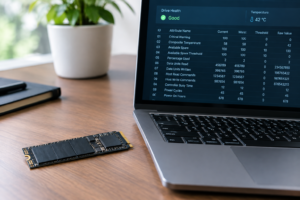
First, don’t panic over the color alone. Open the detailed attribute view in CrystalDiskInfo and check which specific value triggered the status change. Right-click the drive and look at raw values, not just the normalized score.
Second, check if your drive manufacturer has its own diagnostic tool. Samsung Magician, Crucial Storage Executive, and WD Dashboard often give more context specific to that drive’s actual endurance rating rather than CrystalDiskInfo’s generic interpretation. If you’re on a Samsung drive, it’s also a good time to confirm your firmware is up to date, since some health reporting bugs have been fixed in later firmware revisions.
Third, if the warning is confirmed and real, back up now rather than waiting. Even a drive showing “Caution” with climbing pending sectors can go from usable to unreadable within weeks. If you decide it’s time to move to a larger or faster drive anyway, check out our walkthrough on upgrading to a larger SSD, which covers cloning and drive selection together.
Frequently Asked Questions
Does a “Caution” status mean my SSD is about to fail?
Not necessarily. “Caution” often just means one attribute crossed a manufacturer-defined warning threshold, which can happen from normal wear, high power-on hours, or heavy write usage. Check the specific attribute values before assuming failure is imminent.
Can CrystalDiskInfo be wrong about a drive’s health?
It can be misleading rather than outright wrong. It’s accurately reporting what the drive’s firmware provides, but different manufacturers calculate and expose that data inconsistently, so the same percentage can mean very different things on different drives.
Should I trust the health percentage more than individual SMART attributes?
No. The percentage is a convenient summary, but the individual attributes like reallocated sectors, pending sectors, and NVMe critical warning flags give you a far more reliable picture of actual drive health than the single number alone.

James Kennedy is a writer and product researcher at Drives Hero with a background in IT administration and consulting. He has hands-on experience with storage, networking, and system performance, and regularly improves and optimizes his home networking setup.