Samsung T7 Shield vs LaCie Rugged SSD: Drop-Test Durability Compared
Portable SSDs are only as good as their ability to survive real life. You can have the fastest read/write speeds on paper, but if your drive shatters after slipping off a tailgate or tumbling out of a backpack, none of that matters. Two of the most popular rugged portable SSDs on the market, the Samsung T7 Shield and the LaCie Rugged SSD, both promise to take a beating and keep your data intact. But how do they actually compare when put through real abuse?
I’ve been testing both drives side by side, focusing on the things that matter most when you’re working in the field, traveling, or just accident-prone: drop resistance, water protection, dust sealing, and overall build quality. Here’s how they stack up.
Build Quality and Design Philosophy
These two drives take very different approaches to ruggedness, and you can see it the moment you pick them up.
The Samsung T7 Shield wraps its internals in a rubber outer shell with a textured surface. It’s compact (about the size of a credit card, just thicker), lightweight at roughly 98 grams, and pocketable. Samsung clearly designed this for people who want durability without bulk. The rubber coating provides grip and shock absorption, but the drive itself doesn’t have any exposed metal or hard bumper elements.
The LaCie Rugged SSD, on the other hand, takes a more aggressive approach. It features a distinctive bright orange rubber bumper that wraps around the entire enclosure, with a harder core underneath. It’s noticeably larger and heavier than the T7 Shield, tipping the scales at around 110 grams. LaCie (owned by Seagate) has built the “Rugged” brand on the promise of surviving professional abuse, from film sets to construction sites. If you’ve explored our roundup of the best portable SSDs for travel in 2026, you’ll recognize this drive as a perennial favorite among adventure photographers.
Drop Test: Concrete, Carpet, and Everything Between
Both manufacturers advertise drop resistance up to 3 meters (roughly 9.8 feet) onto a hard surface. In practice, real-world drops aren’t always clean, controlled falls. Drives tumble, bounce off edges, and hit at awkward angles.
Waist-Height Drops (3-4 feet)
Both drives handled waist-height drops onto concrete without issue. No read/write errors, no visible damage, no performance degradation. This is the most common real-world scenario (your drive slides off a desk or falls out of a pocket), and both passed with flying colors.
Head-Height Drops (5-6 feet)
At head height, things get more interesting. The Samsung T7 Shield’s rubber shell absorbed impact well, though repeated corner drops started to show scuff marks on the rubber. Data integrity remained perfect. The LaCie Rugged SSD’s thicker bumper distributed force more visibly, with the orange rubber compressing and bouncing. Again, no data loss on either drive.
Maximum Rated Height (9-10 feet)
At the 3-meter mark, both drives survived flat drops onto concrete. When dropped corner-first at this height, the T7 Shield showed minor cosmetic damage to the rubber shell but continued working normally. The LaCie’s bumper absorbed the corner impact with less visible wear, likely due to the thicker rubber surround. Both drives maintained full functionality and passed verification checks afterward.
Verdict on drops: The LaCie Rugged SSD has a slight edge in repeated high-impact scenarios thanks to its thicker bumper, but the Samsung T7 Shield is remarkably tough for its size. For everyday accidents, you won’t notice a difference.
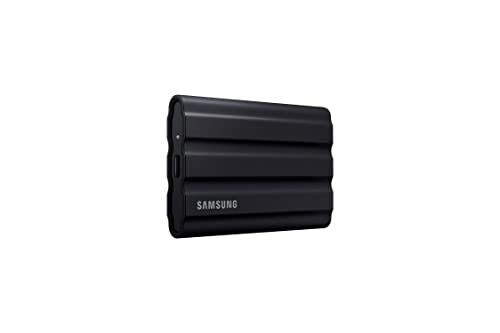
Samsung T7 Shield Portable SSD
Best balance of compact size and rugged drop protection for everyday carry and travel
Water and Dust Resistance: IP Ratings Explained
This is where the spec sheets reveal a meaningful difference between these two drives.
The Samsung T7 Shield carries an IP65 rating. The “6” means it’s fully protected against dust ingress (the highest dust rating possible). The “5” means it can withstand low-pressure water jets from any direction. In practical terms, it’ll survive rain, splashes, and dusty environments without issue. You should not submerge it in water, though.
The LaCie Rugged SSD also carries an IP67 rating. It shares the same top-tier “6” for dust protection, but the “7” for water means it can handle temporary submersion in up to 1 meter of water for 30 minutes. This is a genuine upgrade over the T7 Shield if you’re working near water, kayaking, or shooting in heavy downpours.
For field photographers, videographers working near rivers or oceans, and anyone who’s ever had a drink spill near their gear, that IP67 rating on the LaCie provides real additional protection. If you primarily use your drive in an office or hotel room and just want weather resistance for occasional outdoor trips, the T7 Shield’s IP65 rating is more than adequate.
One thing worth remembering with either drive: water resistance ratings apply when all ports are dry and free of debris. Always dry the USB-C port thoroughly before connecting. If your drive ever does take a dunk or a serious impact, knowing how to recover data from a failed external drive can save you in a worst-case scenario.

LaCie Rugged SSD
Superior IP67 water resistance makes this ideal for outdoor professionals working near water
Performance Under Stress
Durability isn’t just about surviving physical abuse. It’s also about maintaining performance after that abuse. Both drives use NVMe-based internals with USB 3.2 Gen 2 connections, delivering sequential read speeds around 1,050 MB/s.
After repeated drop testing and exposure to dust and water, both drives maintained their advertised speeds within normal variance. Neither showed signs of internal damage or degraded NAND performance. This is one of the major advantages of SSDs over traditional hard drives. There are no moving parts to jar loose. If you’re curious about why SSDs are so much more resilient than spinning disks, our comparison of SSD vs HDD breaks down the fundamental differences.
One area where the Samsung T7 Shield pulls ahead is thermal management during sustained writes. The rubber shell dissipates heat slightly better than the LaCie’s thicker bumper, which can insulate the drive. During extended file transfers (moving 100GB+ of video footage, for example), the T7 Shield maintained consistent speeds for longer before thermal throttling kicked in. The difference is modest, maybe 10-15 seconds more sustained peak performance, but it matters for large transfers.
Over time, both drives will experience some natural performance changes as the NAND cells age. If you notice either drive slowing down after months of heavy use, our guide on why your SSD slows down over time has practical fixes.
Which One Should You Actually Buy?
After putting both drives through their paces, here’s my honest take.
Choose the Samsung T7 Shield if:
- You want the most compact and lightweight rugged SSD possible
- Your primary risks are drops, dust, and occasional rain or splashes
- You do long file transfers and want slightly better sustained write performance
- You prefer a more subtle, pocketable design
Choose the LaCie Rugged SSD if:
- You regularly work near water (rivers, oceans, pools, heavy rain)
- You need the extra submersion protection of IP67
- You prioritize maximum physical impact protection over compactness
- You’re already invested in the LaCie ecosystem or prefer Seagate’s warranty support
For most people, the Samsung T7 Shield hits the sweet spot. It’s smaller, lighter, performs slightly better under thermal load, and its IP65 rating handles everything short of actual submersion. But if your work takes you into environments where a drive might genuinely end up underwater, even briefly, the LaCie Rugged SSD’s IP67 rating is worth the extra bulk. When planning your purchase, it’s worth checking if either drive shows up in the Black Friday SSD deals to get the best value.
My pick for most users: The Samsung T7 Shield. It delivers 90% of the LaCie’s ruggedness in a noticeably smaller package, and the performance edge during sustained transfers is a nice bonus.
Frequently Asked Questions
Can I use the Samsung T7 Shield or LaCie Rugged SSD with a Mac?
Yes, both drives work with Mac out of the box. They ship formatted in exFAT, which is compatible with both macOS and Windows. If you want to reformat to APFS or Mac OS Extended for better Mac performance, you can do that through Disk Utility. For a full walkthrough on connecting external storage to Apple laptops, check our guide on how to connect an external SSD to a MacBook Pro.
Do rugged SSDs last longer than regular portable SSDs?
The NAND flash inside rugged and non-rugged SSDs has similar lifespans, typically measured in terabytes written (TBW). What rugged drives protect against is physical damage that could kill a non-rugged drive instantly, like a drop onto concrete or exposure to rain. The internal components will last just as long, but the enclosure is far more likely to keep them safe for the full lifespan of the NAND.
Is IP65 water resistance enough for outdoor photography trips?
For the vast majority of outdoor use, yes. IP65 protects against rain, splashes, and dust storms. You’d need to upgrade to IP67 (like the LaCie) only if there’s a genuine risk of your drive being submerged, for example, if you’re shooting from a kayak or working near waterfalls. A few drops of rain on your T7 Shield during a trail shoot won’t cause any problems.
This article contains affiliate links. We may earn a small commission at no extra cost to you.

James Kennedy is a writer and product researcher at Drives Hero with a background in IT administration and consulting. He has hands-on experience with storage, networking, and system performance, and regularly improves and optimizes his home networking setup.